亞利桑那大學數學模型集合
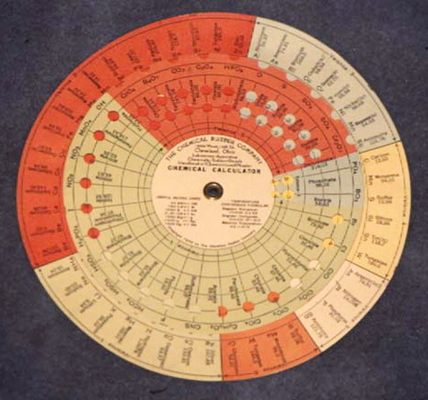
A cabinet of curious mathematical models and old calculators.
關於這個地點
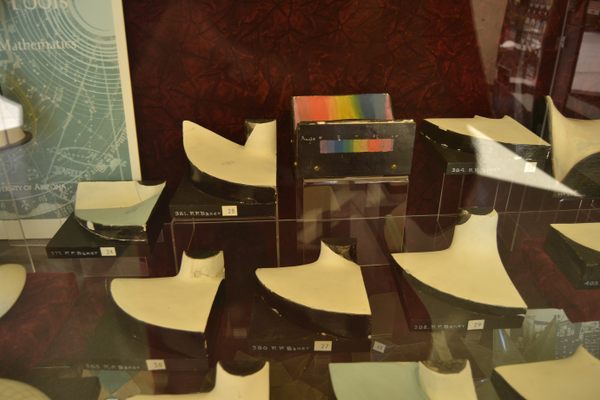
There is a small but worthy cabinet of mathematical models and calculating machines in the University of Arizona math building. Originally used to teach undergraduates, these models are now appreciated for their simple elegance.
The models are examples of a movement in the late 1880s to the 1930s to reform mathematics education. The models were used to demonstrate math concepts in a three-dimensional manner. One set of models, called the Baker models, were produced commercially by Richard P. Baker, an Oxford-educated mathematician who moved to Chicago in around 1900 and started selling models to universities and schools.
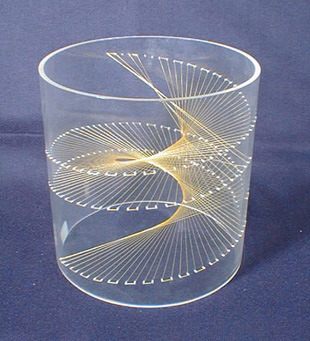
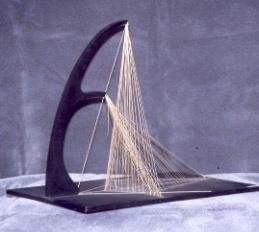
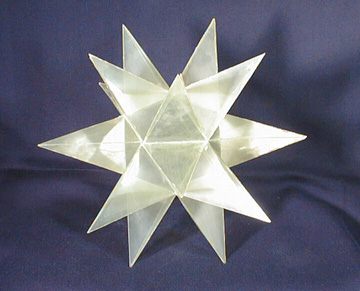
His first catalog described 100 models and had grown to over 500 by the time of his death in 1937. His catalog demonstrated an "enormous range, including solid geometry, projective geometry, algebraic geometry, Riemann surfaces, surfaces from the theories of electromagnetism and thermodynamics, and representations of probability distributions." He also made models of complex electromagnetic reflections which are included in the collection and are often not taught to undergraduate students.
The Baker model collection is the most extensive collection in the western US and one of only a few Baker collections in the United States, including one at the National Museum of American History at the Smithsonian Institution .
The models may no longer be relevant in a computer age, but the skill and craftsmanship can still be appreciated as works of art.
每週透過 Atlas Obscura Places 通訊了解更多不尋常和非凡的地方。
延伸圖集