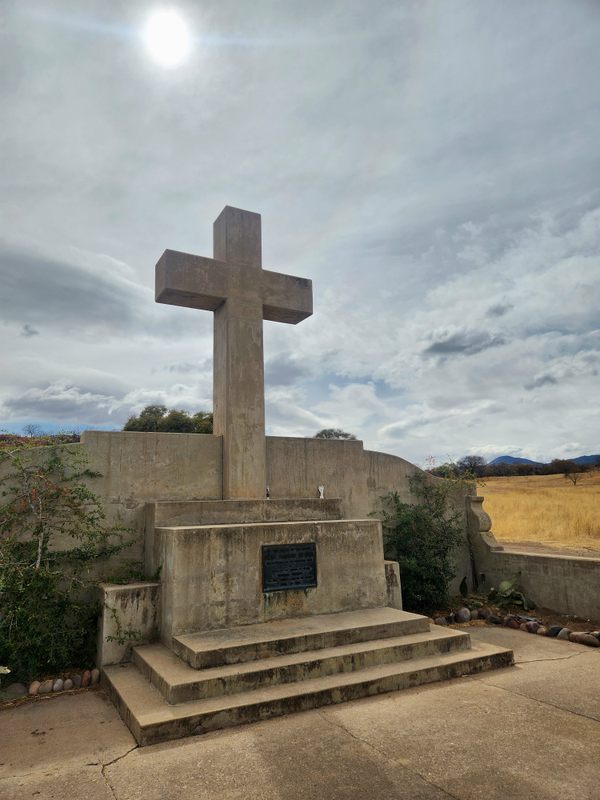
Marcos de Niza Monument
A remote desert monument marks where a priest and explorer entered what later became Arizona.
關於這個地點
Marcos de Niza was born in Nice, which is today in France but was at the time part of the Duchy of Savoy, in approximately 1495. It is unknown whether Marcos was ethnically Italian or French – the Duchy of Savoy was a largely Italian state, but with a sizable French population. He would have likely originally been known as either Marco da Nizza or as Marc de Nice. He was ordained as a Franciscan priest in the Catholic Church, moved to Spain, and entered that country’s service. Adopting the language and naming customs of his new home, he became known as Marcos de Niza, which is the name history remembers him as.
In 1530, Marcos was dispatched to the new Spanish colonies in the Americas and traveled widely. He accompanied conquistadors in what would become Nicaragua, Peru, Ecuador, and Guatemala, serving as a priest alongside the conquering armies but also speaking out against atrocities committed against the native population. Marcos rose quickly through the priestly ranks and was appointed to a prominent position in Mexico.
In 1536, four men from the doomed Narváez Expedition reached Mexico City, the only survivors out of around 600 that had gone missing eight years earlier. They had been stranded on the western coast of Florida and over the years had slowly managed to make their way along the Gulf Coast and down through what is now Texas and northern Mexico, before eventually returning to Spanish-controlled territory. The survivors chronicled their journey, recounting observations of foreign tribes, geography, plants, and animals. Most enticing to the Spaniards, however, were the rumors the survivors had about magnificently wealthy tribes and cities to the north of the area Spain controlled.
Today it is believed that the rumors of fabulously wealthy cities in the American Southwest were clever lies by the Native Americans, designed to encourage the pillaging Spaniards to seek their treasure elsewhere, but Spain took the bait. In 1538, Marcos de Niza was chosen to lead a scouting expedition to find the alleged cities of gold.
Marcos de Niza returned from his expedition to Mexico City in 1539. He claimed to have seen from a distance a city larger than Mexico City, with buildings many stories high, and that his native guides told him that this was the smallest and poorest of the legendarily wealthy cities. Marcos’ fame grew and he was appointed to become head of the Franciscan order in the Spanish colonies. Meanwhile, Spain’s desire to conquer the cities of gold intensified and Marcos de Niza’s report added credibility to the rumors that they were real.
The conquistador Francisco Vázquez de Coronado was chosen to lead a much larger expedition of nearly 2,000 people to plunge into the area north of the colonies, claim the territory for Spain, and capture its great wealth in 1540. Despite his new position with administrative duties in Mexico City, Marcos de Niza was chosen to help guide the Coronado Expedition. Following his directions, the expedition was led to a small native village with only a handful of earthen houses, nothing at all like the fabulous city described in his report. Outraged, Coronado sent Marcos de Niza back to Mexico City in disgrace.
延伸圖集