Battle of Picacho Pass Monument
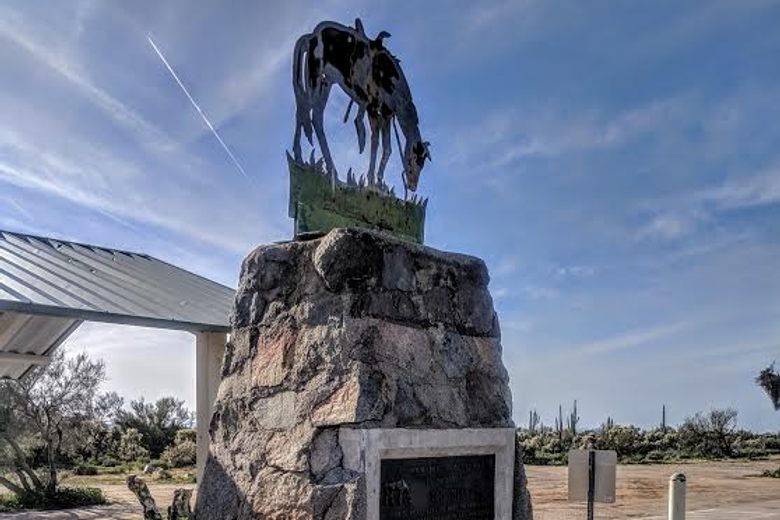
A stone pillar marking the location of the westernmost battle of the American Civil War only honors one side of the conflict.
About
For thousands of years the distinctive silhouette of Picacho Peak has guided travelers across the Sonoran Desert. In 1858 the Butterfield Overland Mail Company, a stagecoach delivery company, began using the nearby lowlands on their route connecting Tucson and Phoenix . The most notable event in the mountain's history occurred several years later, after the outbreak of the American Civil War.
On March 28, 1861 a delegation in Tucson declared that Arizona was a territory of the Confederacy and opposed to the United States. Without soldiers or political power, the declaration by secessionists in Arizona seemed to have little impact. About a year later, however, cavalry from Texas began harassing Arizonans who were still loyal to the United States. The rebel cavalry reportedly wanted to make a loud entrance into the American Southwest to attract sympathizers from California into joining the conflict. This mostly backfired, instead leading to a successful recruitment of Union volunteer regiments to push the Confederates out of the neighboring territory.
The larger goal of the Confederate incursions into Arizona was to control the Butterfield Overland Mail stagecoach road and with it, the easiest access to California. Subsequently, a number of conflicts occurred along that route. On April 15, 1862 a group of Union scouts were on patrol, searching for Confederate scouts that were rumored to be nearby. About a mile north of the Picacho Pass mail station, the Union scouts surprised three Confederate lookouts who surrendered immediately and gave up the Confederate scouts’ location.
Although their orders were to report their position and wait for reinforcements, Union officer Lieutenant James Barrett was eager for a chance to prove himself. The Union soldiers charged at the Confederates and they exchanged fire for 90 minutes. Barrett died almost immediately, and eventually the leaderless Union soldiers retreated. The final toll of the battle was three dead and three wounded on the Union side and two wounded and three captured among the Confederates.
Although this was a fairly inconsequential engagement in the larger picture of the American Civil War, the Battle of Picacho Pass is now remembered by history as the war’s westernmost battle. (A skirmish occurred further west at Stanwix Station, but the encounter was so brief and small that most historians don't regard it as a true battle.) It was also the high-water mark of the Confederate’s westward advance. Retreats were ordered across Arizona and New Mexico , and by July 1862 Confederate troops had returned to Texas.
Today, the site of the battle is memorialized within Picacho Peak State Park. Each year, actors put on a reenactment of the battle—the event has grown so popular that many more actors take part in the engagement than actually happened. Many monuments to the battle have been placed at the site, though many were made of wood and fell apart over time. The only remaining monument at the site is a stone pillar commemorating the Confederate soldiers who fought there.
Gallery