"Chinese Mary" in Wyoming
Arizona Chinese Historical Association Zhang Zhaohong In the western United States, there are Chinese women called "Chinese Mary", but it is difficult to find their real names. In the 19th century and...
Arizona Chinese Historical Association Zhang Zhaohong
In the western United States, there were Chinese women called "China Marys", but it is difficult to find their real names. Racist prejudice in the 19th and 20th centuries meant that Chinese people were often excluded or had no names in newspapers or written reports. In historical records, Chinese women are even more invisible.
In their daily lives, most Americans often refer to Chinese men as "John" and Chinese women as "Mary" instead of calling them the transliterations of their Chinese names. There was a "China Mary" in Tombstone, Arizona, who became the "Queen of Chinatown" in the town's Chinese community.
In the town of Evanston, Wyoming, there is also a "Chinese Mary", who is identified as "Ah Yuen". "Yuen" is a Cantonese surname. Because the Chinese place the surname before the first name, the surname is often incorrectly listed as the first name on official documents. "A" is a Chinese prefix, plus the abbreviation of a person's name to indicate familiarity. Based on this, "A Yuan" is probably not her name.
As Christopher Merritt of the Utah Department of History explains in "A Yuan's" biography, U.S. Census Bureau records show that she arrived in the United States around 1863. She was probably born in southern China between 1848 and 1854. This will make her look quite young during her long trip to the United States.
>A Yuan’s trip to the United States was probably not a pleasant one. Chinese immigrants often sat in the cockpit, the lower deck of the ship where cargo was stored. These passengers are often packed into hundreds of people in a large cargo hold. The beds are usually rows of large shared bunks with straw mattresses and no sheets. Travelers' privacy and security are limited, sanitation is inadequate, and food is scarce. The voyage may take several weeks.
Why she came to the United States is unclear. We do know that between the 1840s and the 1860s, people living in China faced violence from civil war, rampant unemployment, dispossession of land and wealth, famine, and overpopulation in coastal cities. Girls in China are even more disadvantaged.
Chinese families facing financial difficulties and hunger often decide to sell their daughters overseas, not only to survive, but also to give them a chance at a better life. In this case, most girls accepted their family's decision out of filial piety and allowed themselves to be sold to Chinese "labor contractors." Maybe A Yuan is one of the girls? Her birth and immigration dates are consistent with that period.
Because daughters could not provide the hard physical labor required to support a family or carry on the ancestral name, they were considered inferior to sons and therefore expendable. As more and more Chinese men immigrated to the United States without wives, a natural prostitution market emerged.
Some of the more attractive girls are not forced into prostitution, but are "lucky" to become concubines of wealthy owners, who may treat them decently, although their owners can send them back to the auction block if they are undesirable. Most girls did endure prostitution, however, ending up in high-end brothels reserved for Chinese men, or in "huts," where they served anyone from sailors to teenage boys to drunkards for 25 to 50 cents.
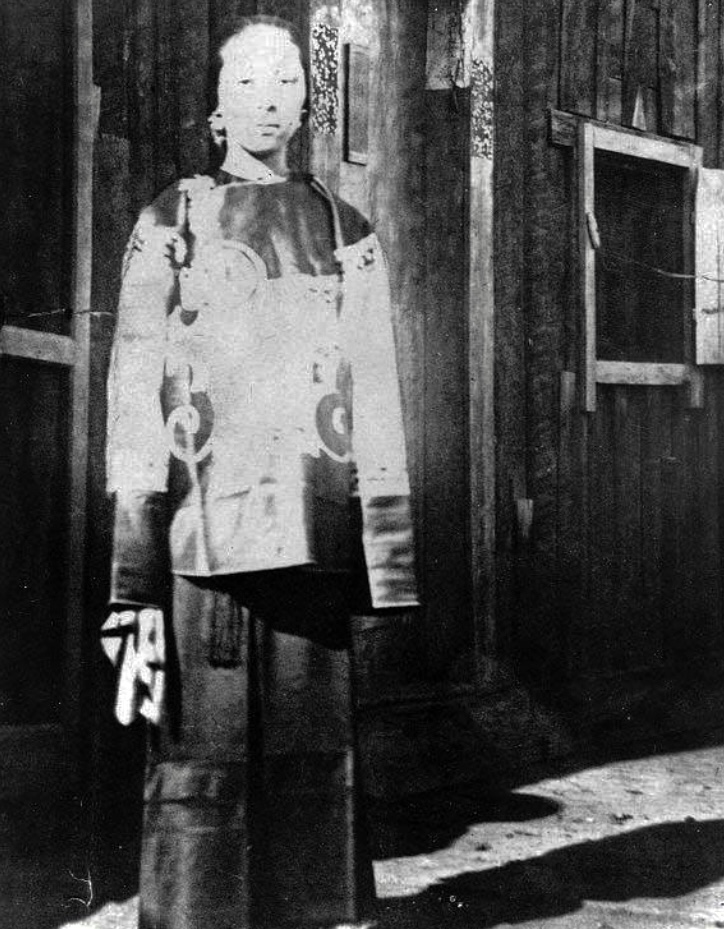
>A Yuan may be one of the lucky ones. She was an exceptionally beautiful woman, according to a Works Progress Administration-era biography in the Wyoming State Archives. It is said that this is a photo of A Yuan. Location and date unknown. Image from the collection of the Uinta County Museum, Evanston, Wyoming.
A Yuan’s life story shows that she, like many Chinese immigrants, began her journey to the United States in San Francisco. At some point, she was in Denver, but that part of her history remains a mystery.
In 1868, she was working as a cook in Bear River, Wyoming. She was probably married at this time, to a railroad worker, as Bear River was an end-of-track town during the construction of the Transcontinental Railroad. She recalled witnessing what is now known as the Bear River Riot on November 19, 1868, following the lynching of a murder suspect who worked for the railroad. The town erupts into violence when friends of the lynched man resist the vigilantes. 16 people died. Later in life, she would show interested parties a long trench where bodies were buried.
By the 1880s, she was living in Park City, Utah, where Chinatown formed when parts of the first railroad into the city were built by Chinese workers. A Yuan and her husband opened a store selling Chinese goods to local laborers and European Americans. Life there may have been unsettling for the couple. According to an article in the Encyclopedia of Utah History, as early as the first decade of the 20th century, Park City's Chinese were sporadic victims of racial prejudice.
After the death of her husband, Ayuan moved to a place about 65 miles east of Evanston, Wyoming around 1900. She may be in her late 40s or early 50s. Why Evanston? Maybe opportunity is calling. The city has lost its wildness.
When Ayuan arrived, Union Pacific worked with the Pacific Fruit Company to develop an icehouse between the railroad tracks and the Bear River. Union Pacific also built a brick warehouse to replace the first wooden warehouse. Soon after, Evanston had a federal courthouse and post office. The town even has one of the few Chinese temples in the United States, known as the "Joseph House," which was built in 1894. In 1922, fire destroyed this Chinese temple when Evanston's Chinatown burned down. Many Chinese had left Evanston by this time, but Ayuan was one of the few who stayed.
After moving to Evanston, Wyoming, Ayuan got married twice more. Her last husband was a gardener known as "Mormon Charlie," whom she probably married in the late 1920s. His name is recorded as Lok Long Cong (or Zhong) and his year of birth is 1862. There is an entry on the Findagrave website where he was given the nickname "because he blended in well with the locals". He immigrated to the United States in 1881. Described as a small man, he is remembered for carrying large quantities of vegetables around town in a basket supported by two long poles. Sometimes he would let the children sit in the basket. He was so popular and trusted that he was allowed to enter people's homes while they were out at night and leave vegetables behind.
WPA's biography states that Ayuan has a cheerful personality and speaks English fluently, and the people who listened to her speeches in San Francisco, Denver and Park City were very happy. She became one of the town characters in Evanston. Tourists asked to take pictures of her, for which she charged 10 cents. In turn, she paid the Evanston children a dime for bringing her fish from the Bear River. She enjoyed gambling and even received assistance from the county for many years before her death. The biography states that she had three children, but does not mention their names or whereabouts.
A Yuan and her third husband, circa 1930. Photo archive: China Mary, American Heritage Center, University of Wyoming, USA.
lived the rest of her life in Evanston until her death in her small home on January 13, 1939. She was a beloved figure in Evanston, and her memorial service was attended by many town residents, and although her grave is in the ghetto section of Evanston Cemetery, her grave is marked, provided by the city. There is also a "Chinese Mary Road" here.
Although the story of A Yuan is mysterious in many aspects, it is difficult to imagine the hardships A Yuan experienced in his motherland and in the United States. Regardless, she embarks on the journey with good spirits and an obvious zest for life.
(This article was provided by AHC Simpson Archivist Leslie Waggener.)
Original author: Ahcadmin, compiled by Zhang Zhaohong
Editor's note: Seeing the photo above always gives me a feeling of déjà vu. I'm reminded of Arizona's "China Mary". She left no written information or photos in Tombstone, but one photo that has been widely circulated has become well-known and widely used in newspapers, magazines, documentaries and other media. Although this is just an image created by literature, it has already been deeply rooted in the hearts of the people.
So, who is the prototype of this "Chinese Mary" in Tombstone Town? When you see the "Chinese Mary" from Wyoming who is already seventy years old, she is still so graceful and graceful. If you go back twenty years, at fifty years old, would she have a similar beautiful appearance to the "Chinese Mary" from Tombstone?!
These two Marys from China have many similar experiences and are both successful examples of Chinese immigrants. If "A Yuan" of Evanston, Wyoming is really the prototype of "China Mary" of Tombstone, Arizona, that would be the best artistic image!
Sources and usage
This piece is republished or synchronized with permission and keeps a link back to the original source.