The Deng family grew into Chinese Americans (center)
Arizona Chinese Historical Association Zhang Zhaohong Reporter Kathleen Stanton’s article: “THE ONG DYNASTYG…
Arizona Chinese Historical Association Zhang Zhaohong
Reporter Kathleen Stanton’s article: “THE ONG DYNASTYGROWING UP CHINESE-AMERICAN” 2-13-1991.
(Continued from previous issue, translation) Anti-Chinese laws were introduced as early as 1876, and more were passed whenever a recession squeezed the young economies of the American West. Immigration laws became increasingly strict, so that family members were sometimes thrown into customs detention after returning from China, even if they had proof of citizenship. In 1919, Wing F. Ong The 14-year-old boat boy arrived in the United States when he was imprisoned for three months on San Francisco's Angel Island, where authorities double-checked his citizenship. Although born in China, Deng Yuening was a citizen because his father, a laborer, was born in the United States.
In California, thousands of Chinese immigrated to work in the fields, mining camps, and railroads, and a series of disastrous economic problems led to the 1870s. The brutal persecution of Chinese by unemployed white mobs in the 1890s.
Upon arriving in Arizona, they never experienced the level of violence directed against coastal Chinese communities, but instead faced the same persistent discrimination that Chinese like Deng Kailong did in the 1890s. Coming of age, it was easy to target the local media, and in most towns, large or small, there was at least one anti-Chinese hate group
The Arizona Republic 1956. A report in 1999 claimed that Prescott and Tombstone, not Phoenix, were "hotbeds of China-haters." (The Republic's article, while sympathetic, failed to note that its predecessor, the Arizona Republican, had spearheaded the race-baiting in 1890 when the Chinese first arrived in Phoenix. When the Chinese population reached double digits, the newspaper showed that "the cunning Mongolians should be confined to the smallest possible area.")
"When I was a child, even in third-rate theaters like the old Rialto (downtown Phoenix), the Chinese had to sit on the balcony," Deng Yueyin ( Fred Ong recalled, “Even in theaters where Hispanics were allowed in the main area, we had to stay in the balcony. " He was unable to find any job of permanent or status until after World War II, by which time he and his three brothers had already served in the armed forces. Last year (1990), Henry Ong Jr., the only Chinese-American prisoner of war in World War II, came from Arizona. Jr. was honored by Congress for his heroic actions.
In the face of deep-seated prejudice, the family associations established by the Tangs and other Chinese clans were crucial to balancing their chances of survival. Through the Tangs, the Tangs pooled resources to fund new ventures, provide social and emotional support to newcomers, and care for sick or elderly relatives. Because they have to disclose all the information, it could get them into immigration trouble," said Deng Yuetian.
While immigrants from many cultures with strong family ties band together to survive, few other ethnic groups can draw on such a complex or well-organized tradition as the Chinese Family Association. The association here Hui (clan groups) such as the Yu Clan Association, the Huang Clan Association, and the Longgang Clan Association were modeled on the institutions that these clans had developed over the centuries. In China, Deng's clan groups were established by relatives in cities such as Guangzhou, the capital of Guangdong Province, to provide boarding houses, post offices, counseling centers, and social halls for family members who arrived in the city to attend school. Doing business or visiting. (Deng Yueyin and Deng Yuedian went back to Guangzhou, China to attend high school and junior high school when they were young, so they are both good at Chinese and English. Both brothers have served as chairman of the Chinese Chamber of Commerce. Editor's note.)
Even now, when the family's reliance on Deng's office has been reduced to a weekly mahjong match and few social occasions, the office remains afloat through the dedication of its members. "My father always said you have to understand your own culture to become a better person." Deng Yueyin recalled.
A large scroll filled with Chinese calligraphy hangs on the wall of Deng's house in Phoenix City. "This is part of the history of the Deng family written by my father," Deng Yuedian said. "My father was famous for his calligraphy. Although he had little formal education, he taught himself calligraphy and we consider calligraphy an art form." Another scroll conveys the Deng couple's good wishes from a school in their hometown that they donated after their commercial success in the United States. Like Ong Ko Met's portrait, the act of donating a school that Phoenix's Tang youth will never attend symbolizes strategic rather than sentimental value.
Deng Yueyin's cousin Wing F. Ong later became a lawyer in Phoenix and the first Chinese American elected to the state legislature. He began his formal education by sitting under a tree with other boys in his hometown. His biographer, Arizona State University sociology professor Richard Nagasawa, said Deng was expected to memorize teachings and serve his master loyally (or take a beating).
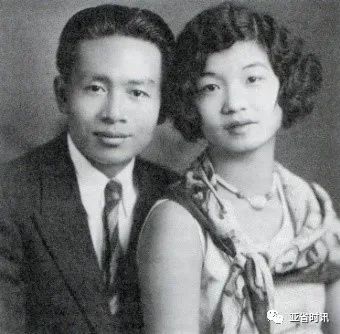
Deng Yuening and Huang Meigui couple
Deng Yuening came to the United States and ambitiously learned English. He joined his uncle Deng Kailong's family in Phoenix because schools here would admit him. In his 1986 biography of Deng, "Summer Wind," Richard Nagasawa said that under California law at the time, Chinese children could even be (and were) excluded from segregated schools if they didn't understand English.
After arriving in Phoenix, 15-year-old Yuening Deng entered first grade at Grant Elementary School, a new school on Adams Street west of downtown. He completed elementary school in four years and graduated from Phoenix Union High School two years later.
Deng Yuening’s first exposure to politics was in high school, when he worked as a valet for Governor Thomas E. Campbell. The Campbells were so impressed with him that they later helped him through law school at the University of Arizona. Deng Yueyin recalled that his cousin Deng Yuening was "very dedicated and ambitious."
Deng Yuening's daughter, Madeline Ong-Sakata, said her father was outgoing, talkative and a keen observer of American customs and politics. “Dad knows the system,” she said. "A lot of Chinese-Americans don't know how to play this game, but my father knew it, and he played it."
Like most second-generation Chinese in Phoenix, Yuening Deng initially followed his uncle and cousin into the family business. But his career ambitions exceeded those of most of his generation and shocked some of his relatives, according to his children.
Just as Deng Yuening was preparing to enter a traditional marriage arranged by his uncle Deng Kailong, Deng Yuening told him that he wanted to become a lawyer one day. Deng Yuening's daughter Madeline said her father's marriage to his 16-year-old mother, Rose Wong, was a two-way commitment and that he had never met her before she came from China for the wedding. "She promised to support his goal of becoming a lawyer, but in return he had to promise to help her siblings immigrate," Madeleine said. "That's how arranged marriage works. It's an agreement and both parties get something out of it."
Their grocery store's profits are measured in pennies, and their first child is born in the back room. Nonetheless, Madeleine recalled, "My father made good on his promise and brought my uncle and aunt over, and they helped mom run the store while my father went to law school in Tucson."
Wing F. Ong Grocery Store (1925)
(Photo from Phoenix Museum and Network)
Sources and usage
This piece is republished or synchronized with permission and keeps a link back to the original source.