Pearl of the Desert | Chinese History of Arizona, USA (66) Original historical books and publications - The Heroic Chronicles of Arizona Chinese Soldiers in World War II (continued)
Arizona Chinese Historical Association Zhang Zhaohong Douglas L. Dong, a Chinese soldier, joined the U.S. Army in January 1942,...
Arizona Chinese Historical Association Zhang Zhaohong
Chinese soldier Douglas L. Dong, joined the U.S. Army in January 1942. After training at a California base for two weeks, he went to the front line. He was transferred from Bombay, India to Kunming, China, and was stationed in the 14th U.S. Air Force Group, where he became a forward operator and fought on the front line.
Harry Ong is a sergeant in catering services. There are only a few lines in the information: "Harry Ong, Enlisted in the U.S. Army Air Corps on February 2, 1942. In April 1944, he departed from Newport, Virginia, to Bombay, India, and then transferred to Kunming to join the Air Force Task Force of the 14th Air Force in China. He was later assigned to Shanghai, China, where he met his future bride, Jean. "
In the European battlefields of World War II, many Chinese soldiers from Alberta participated in famous battles.
U.S. Army Artillery Commander Robert E. Ham, who joined the Arizona National Guard in Mesa (MESA) in July 1940 and was a reserve member of the West Point Military Academy. He participated in many major battles in World War II, including the defense of the Panama Canal Zone. He traveled to the United Kingdom, France, Belgium and other countries, and participated in the Battle of the Rhineland in Germany and the Battle of Normandy in France. In a massive Army attack on the Ruhr River, their troops withstood the flooding caused by the Germans' blown dams, captured Cologne and completed the Rhineland Campaign. Robert E. Ham served in the Army for 40 years and retired in April 1981 with the rank of Lieutenant Colonel.
Kun Dan Gong, he is a B-24 heavy bomber maintenance pilot. He moved to the European theater and repaired fighter aircraft at bases in England, Greenland, Montreal, Canada, Iceland, etc. Participated in the European air offensive, Italian campaign, Sicily campaign, Normandy campaign.
Henry Ong served as a radio operator on the B-24 bomber, which was a heavy bomber at the time. They often perform missions at night, bombing deep into the enemy's territory. On August 6, 1944, Deng Yuedian carried out his 30th mission to bomb the engine factory in Berlin, Germany. However, the plane was hit by artillery fire and the crew parachuted out and were captured by the Germans. In February 1945, the Germans moved the entire prison camp. Deng Yuedian and more than 10,000 prisoners of war began a "death journey" and walked a thousand miles from east to west Germany. Because the battle situation was unfavorable to the Germans, they turned back from the west to the east. On May 4, 1945, Deng Yuedian was rescued by the British army.
Quan Wing Yip's unit is the 101st Airborne Division of the US Army. It is an air assault force of the US Army. During World War II, it was sent to the European battlefield and its first participation was the Battle of Normandy. On the night of June 5, 1944, he parachuted down with his troops on the coast of Normandy between Caen and the Cherbourg Peninsula. His mission was to ensure the safety of the bridge and cut off the German army's communications and supplies.
During World War II, eight Chinese soldiers from Alberta joined the U.S. Navy. Some of them participated in the "Battle of Midway", some participated in the "Battle of Iwo Jima", and some witnessed the historical moment when the Japanese aggressors unconditionally signed the instrument of surrender on the battleship "Missouri". Although they were just ordinary navigation and communication soldiers or gunners, they added a lot of color to the history of the Chinese in Arizona during those magnificent war years.
>Dong M. Hom joined the U.S. Navy in February 1944. After eight weeks of training at the Idaho Recruit Training Camp, he became a signal and communications officer in navigation. He then went to the Pacific battlefield, from the Battle of Midway to the Battle of Iwo Jima, to provide fuel to the fighting fleet.
Tom Bon Yee, a Chinese-born Navy man, enlisted in the army in 1943. After training at the San Diego Naval Base, he served on the USS Missouri as a gunner on the ship. On March 18, 1945, the USS Missouri cooperated with Mitchell's fast aircraft carrier group in air attacks on airports in the Kyushu region of Japan and ships in the Seto Inland Sea. Later he participated in the attack on Okinawa.
On August 15, 1945, Japan announced its unconditional surrender. On September 2, 1945, the U.S. Navy officers and soldiers on board the Missouri stood on the platform, climbed to the fort, and sat on the fence to witness with their own eyes the extremely vicious Japanese Empire in the past. Yu Mingde was one of them, and he witnessed this solemn moment in history.
During the Second World War, the "Philippine Chinese National Salvation Support Association" actively purchased the Chinese government's "war bonds". In late March 1943, the "American National Salvation Association" There is a paragraph in the article in the daily that makes the Chinese in Phoenix City particularly proud: "The Feini Overseas Chinese National Salvation Support Association launched a donation campaign to help build a nursery for needy children in the country, and selected Deng Yisheng, Yu Kangzhong, Deng Jueshi, Sixteen people including Deng Yaoshi, Deng Wenhua, Deng Xiangquan, Guan Chongqiong, Deng Yulong, Deng Kailong, Deng Tongyan, Deng Ziyi, Deng Xielong, Deng Yiye, Deng Shulong, Deng Zhishi and Deng Fuzhang were fundraisers. The national currency of 230,000 yuan, valued at 12,000 U.S. dollars, was handed over to the welcoming representatives and brought to San Francisco to present to Mrs. Chiang. "Among the 26 Chinese associations in Western American cities that year, Fei Ni overseas Chinese ranked first in the number of donations.
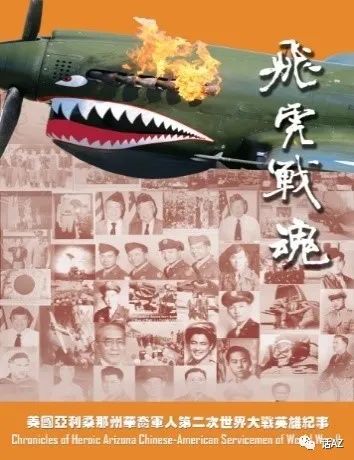
"Chronicle of the Heroes of Chinese-American Soldiers in Arizona in World War II" was published under the name of "Flying Tiger Fighting Spirit". It combines the description of the battle deeds of Chinese-American soldiers with the background of the times, allowing us to re-experience the heroic spirit of Chinese-American soldiers, realize that the victory is hard-won, and world peace is valuable.
"Flying Tiger Fighting Spirit" designed two covers, with calligraphy by Alberta calligrapher Chen Puti. The Overseas Chinese History Museum of China collected this book and issued a certificate of honor. The Overseas Chinese Affairs Council of Taiwan collected "Flying Tiger Fighting Spirit" into a book to commemorate the 70th anniversary of the victory of the Anti-Japanese War. The Kunming Flying Tigers Museum and many libraries also archived this book.
One of the covers (designed by Sun Jianping)
The author was invited to visit the "Museum of Overseas Chinese History"
Sources and usage
This piece is republished or synchronized with permission and keeps a link back to the original source.