Pearl of the Desert | Chinese History of Arizona, USA (55) Chapter 4: The History of Four Chinese Families The Deng Anye Family (1)
Arizona Chinese Historical Association: Zhang Zhaohong The Deng Anye Family (1) The two largest historical buildings still preserved by Chinese in the province of Alberta, one was built in 1919 by Deng Kailong...
Arizona Chinese Historical Association: Zhang Zhaohong
>Deng Anye Family (1)
The two largest historical buildings that have survived to this day among Chinese people in Alberta, one is the "Deng Guangdong Warehouse" built in 1926 by Deng Kailong; the other is the "Sun Mercantile Company" built in 1929 by Deng Anye. These two warehouses built with red bricks have the same style. After nearly a hundred years of ups and downs, they still stand in the center of Phoenix. They have become landmarks for the successful entrepreneurship of Chinese people in Alberta and have added rich content to our Chinese history.
In the history of the Chinese in Arizona, the Deng Anye family has made positive contributions in economic, military, legal and cultural aspects. Deng Anye (1889-1954) is a famous figure in this large family.
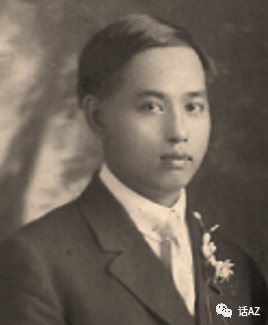
Deng Anye (Shing Tang) in his youth
In 1889, Deng Anye was born in China. His father, Deng Zaoyuan, was one of the first Chinese ancestors to come to Phoenix, United States, but no historical information was left behind. In 1910, 21-year-old Deng Anye came to Phoenix, USA from Guangzhou via San Francisco. His English name was "Shing Tang". He took over the grocery store business at 529 South Street and 7th Avenue from his uncle, Deng Xianyuan, who soon returned to China.
In 1912, Deng Anye opened a new grocery store at 622 South Street and 7th Avenue in Phoenix. In 1914, he married Lucy Sing, who was born in the United States. With the help of his good wife, he continued to run the grocery store for nearly twenty years and became a very successful businessman.
>Sun Mercantile Building
During this period, Deng Anye established the "Sun Mercantile Building" (Sun Mercantile Building) to provide many groceries and food supplies to surrounding towns. In April 1929, Sun Commercial Company moved into a new warehouse at Jackson Street and Third Avenue in Phoenix.
Located near the railroad tracks in the heart of the warehouse district that was developed in the early 20th century, the new warehouse is significant because it was the largest warehouse built by Chinese-born businessmen in Phoenix. Tang hired architect E. W. Bacon to design the red-brick building in the popular Chicago style, which was equipped with a city alarm system and a sprinkler system. The large warehouse has two 14,000-square-foot floors each, making it the largest free-standing building in Chinatown. The value at the time was $80,000. The grand opening took place in April 1929.
> Deng became the number one seller of Del Monte, Arizona products at the time and supplied food goods to major companies such as Safeway and Basha’s, allowing many other businesses to be established. Del Monte Foods is a famous food manufacturing and distribution company headquartered in San Francisco, California, USA.
Sun Commercial Company's business continued to grow and became the largest wholesale grocery business in Phoenix. From its opening until the 1950s, Sun Commercial Company was one of the major suppliers to small grocery stores throughout Arizona. As a successful Chinese entrepreneur, Deng Anye has been recommended by mainstream society, demonstrating the positive contributions made by Chinese people in the economic field of Alberta.
The "Arizona Republic" reported at the time: "This newspaper noticed that Sun Commercial Company is the general merchandise wholesale warehouse with the most classified goods in the state." The company's remarkable growth history has been called "an outstanding chapter in business and development in Phoenix and the Salt River Valley."
The Sun Commercial Company is the only surviving relic of Phoenix's "Second Chinatown" period (c.1890-c.1960). Designated on the Register of Historic Places on September 4, 1985. In 1987, it became a protected historic landmark.
The Arizona Chinese Historical Association collected a picture of Deng Anye. Although the picture is not very clear due to its age, how was this picture preserved?
In the 1930s, Deng An was already a well-known overseas Chinese leader in the Chinese community. He once served as the chairman of the Feini Chinese Chamber of Commerce. During the Anti-Japanese War in 1943, he served as the executive committee member of the "Fei Ni Chinese National Salvation Support Association", contributed money and efforts to the motherland's anti-Japanese war, and left historical records and pictures. When a person has made contributions to the country, the nation, and the Chinese community, many things in the world may be inevitable by accident, but they will never be forgotten. Deng Anye died in 1954 at the age of 65.
Sources and usage
This piece is republished or synchronized with permission and keeps a link back to the original source.