Pearl of the Desert | Chinese History in Arizona, USA (Twenty-seven) The sixth-ranked city: Glendale
Arizona Chinese Historical Association: Zhang Zhaohong Glendale as a community, in its 100-year history, the economy has progressed...
Arizona Chinese Historical Association: Zhang Zhaohong
Glendale as a community, the foundation of its economic progress over its 100-year history can be summed up in two words: water and transportation. Water does more than just meet the daily needs of the city's population, it actually creates local industry.
The Arizona Canal and Roosevelt Dam ensure a stable water supply and protection from droughts and floods. These water sources have made Glendale an agricultural mecca, specializing in the cultivation of lettuce, melons, sugar beets and cotton.
To the north and west of the Salt River Valley, the lands of Glendale and Peoria northwest of Phoenix remain pristine desert 15 years after the cities of the east valley have settled. To bring life to the barren northwest valleys, vital water resources are needed. In 1886, the New Arizona Canal was completed.
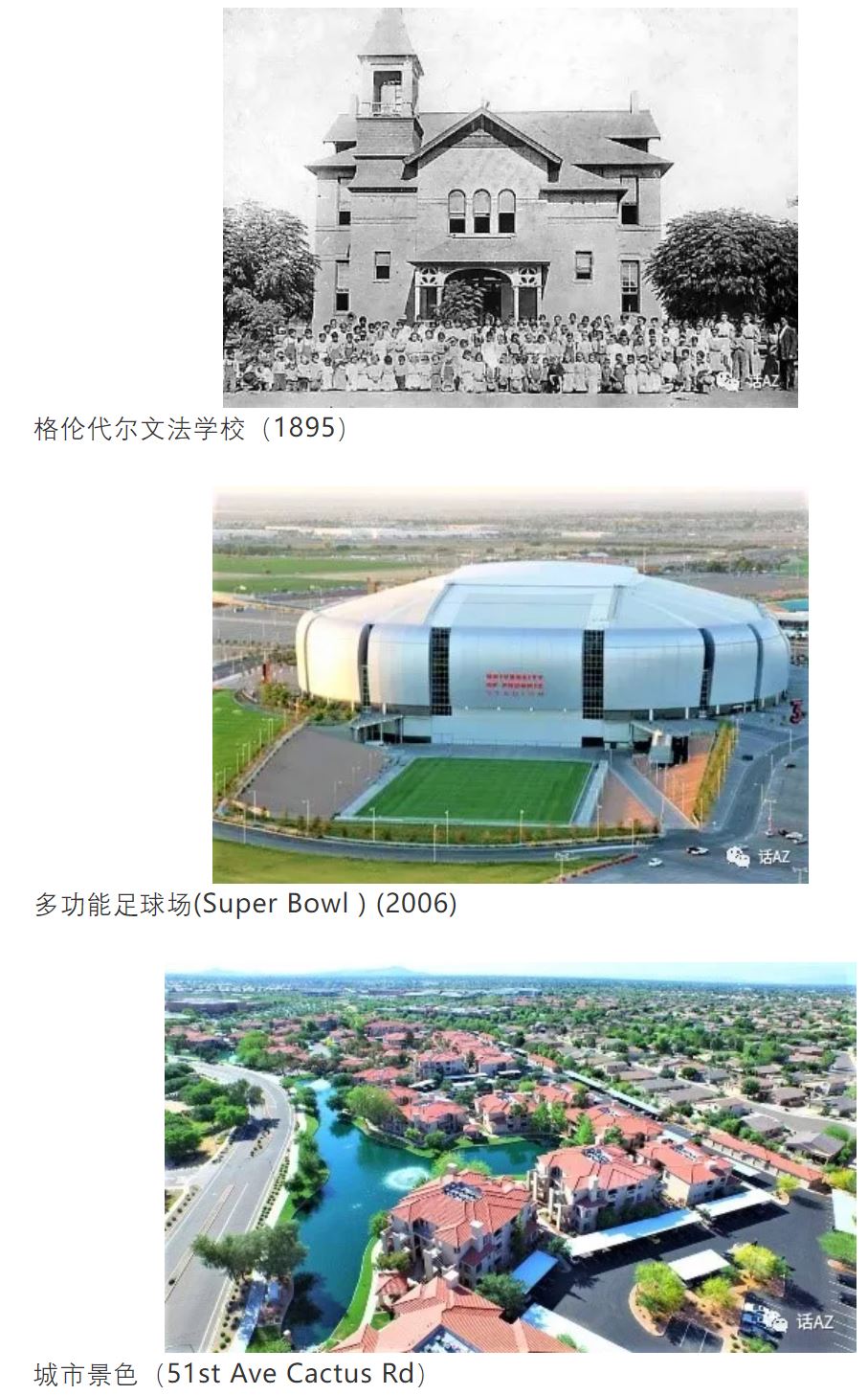
In 1892 Glendale had its first residential district survey and plans. In 1895, the Santa Fe Railroad depot was built along Grand Avenue. In the same year, the first school, the Grammar School, was built. 1910 Glendale's population exceeds 1,000.
In 1912, Glendale's high school was built. In 1930, Glendale became one of the largest agricultural product shippers in the United States, and the town of Glendale became a city.
In 1941, the Air Force School cleared desert land and built Thunderbird Airport to train pilots for the Army Air Force during World War II. Construction also began at Luke Air Force Base. In 1946, Thunderbird Airport was converted into the Thunderbird International School of Management.
In 1948, Glendale became the only city in Arizona with fully paved streets. In 1965, Glendale Community College (GCC) was established. In 1988, ASU West University in Arizona opened.
In 2006, Glendale built a multi-purpose football field (Super Bowl). The first Super Bowl was held in 2008. The second session was held in 2015.
According to the U.S. Census, in 2021, Glendale had a population of 257,233, making it the sixth largest city in Arizona and the 88th largest city in the United States. 3.9% of them are Asian.
The Glendale Arizona Historical Society has a research library focused on Glendale history, including school yearbooks, Glendale newspapers, city maps, city directories and other publications, and also archives obituaries and wedding announcements from many years ago. As part of the "Listening to Glendale's Past" series, 12 oral histories of Glendale's early residents are included. Among them is the only Chinese: Arnold Ong (Chinese transliteration: Arnold Deng).
> Early Chinese in Glendale
Arnold Ong's grandfather came to the United States very early, and then his grandfather brought his father to the United States. His father's name is Gene H. Ong. Around 1930, his father opened a small grocery store at 901 West Hadley Road in Phoenix.
Arnold Ong was born in China and immigrated to Phoenix, USA with his family in 1934.
Later, Arnold Ong’s father purchased two pieces of land in Glendale and opened a grocery store “Gene’s Market” on 60th Avenue and Glendale Avenue.
In 1940, the family moved to the small town of Glendale. Arnold graduated from Glendale Elementary School, attended high school on West Glendale Avenue, and attended Arizona State University, but after his father died in 1950, he had to stop school to take over the family business. Thirty-two years later, in 1983, he sold the store and retired. Have lived in Glendale ever since.
In my childhood memories, Glendale was a quiet farming town and community. But on the weekends, most farmers would drive their trucks into town, where they might stay all day, shop, buy clothes, get a haircut, watch a movie, and then go home.
In Arnold's oral history, in the 1930s and 1940s, Chinese people were restricted and could not own property if they were not citizens. His father got around this by having other U.S. citizens buy the two lots he built. After World War II, his father became a naturalized citizen and the property was transferred back.
They used to live in a small apartment built behind the store. Then he bought a house on Northern Avenue. But if you are a minority, you can be refused the sale of property. He remembers a Japanese doctor who had to build a home west of the railroad that marked an ethnic divide but could not build a home east of the railroad. Glendale had many Japanese families housed in these camps.
Arnold said, We can only keep a low profile and have to post in the store that we are Chinese Americans. It was difficult to distinguish between Japanese and Chinese at that time. The Japanese had to sell their farm, sell it for a few hundred dollars or fifty dollars an acre because they had to give everything up and be put in these relocation camps.
There was discrimination in society at that time. Arnold loves to play football and is active in different clubs. Arnold said that from a social perspective, today and the 1940s are like night and day.
During his four years in high school, there were no students of color in the school. In fact, he doesn't think there are any families of color in Glendale. They didn't appear until later. Some families moved into the Glendale area, where you don’t see many children of color. The Glendale area was off-limits to them, and residents discouraged them from coming in. (to be continued)
Sources and usage
This piece is republished or synchronized with permission and keeps a link back to the original source.