Pearl of the Desert | History of Chinese in Arizona, USA (15) History of Chinese restaurants in Phoenix
1. The earliest "American Kitchen" (American Kitchen) In 1900, there was already...
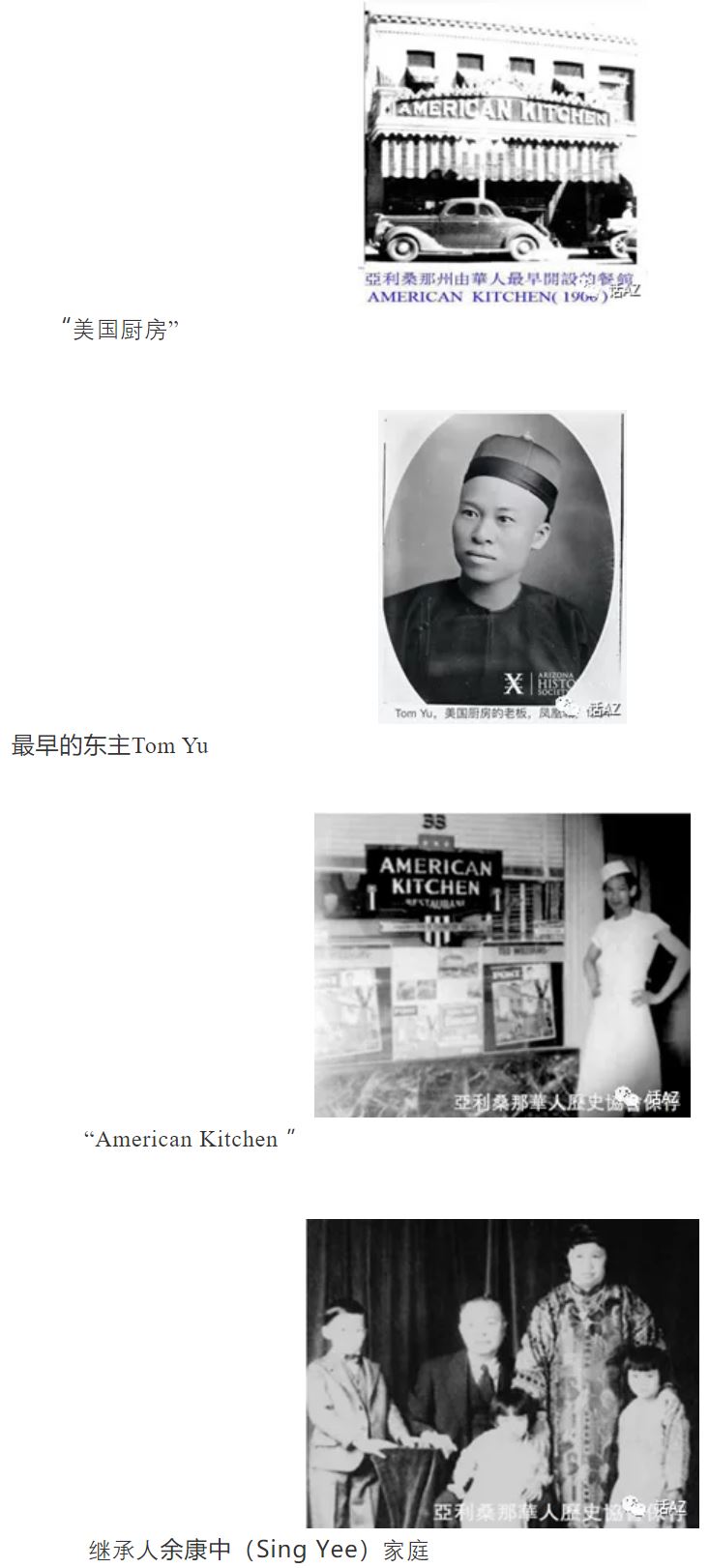
1. The earliest "American Kitchen" in Chinatown in Phoenix (Phoenix) Kitchen)
In 1900, there were already three Chinese, British, and French restaurants in Chinatown in Phoenix, all operated by Chinese. "American Kitchen" is located at 31-33 North Center Street. The earliest proprietor of the restaurant was "Tom Yu", and there is a photo from 1904. The successor is Sing Yee. Yukang Middle School was proficient in Chinese and English, well-run, and had good political and business relations at the time. Many clan members who had just arrived in the port were taken in to work or received help from them. They were the Fei Ni Yu family's heroes in the opening of the port. "American Kitchen" has been a popular restaurant in mainstream society for decades. It has always existed in "First Chinatown" and became one of the few restaurants that was not forced to move to other places. It did not close until January 5, 1951.
By the 1920s, Phoenix had three popular restaurants: the Mandarin Café, the Peking Café and the Gold Dragon.
2. SingHigh Chop Suey House)
In 1928, "SingHigh" (SingHigh) opened. The proprietor was Yu Muxin (English name "Kai Y. Lee"). SingHigh provided traditional "chop suey" meals. Well-known in mainstream society in the United States, this Chinese restaurant opened in a prosperous area of old Chinatown. The restaurant's name was later changed to "Sing High Chop Suey House". The chop suey meals provided have been passed down for three generations and are popular among diners. Many Americans and other ethnic groups fell in love with Chinese food after tasting the "authentic chop suey" from Shanghai House. The restaurant had a history of 90 years from its opening until it was sold in 2019.
In the 1940s, many Chinese restaurants in Phoenix were recorded, including the Golden Shine. Café), China Tea Garden, Hut Sut Café and Rice Bowl, etc.
3. WONG’S CHINESE DINING
WONG’S CHINESE DINING was originally a private building and was built in 1926. .
In 1941, this house was bought by Kew Lung Tang, a Chinese who immigrated to Phoenix from Guangdong, China in 1942. In 1942, he built a grocery store next to his house and named it "K.L. Grocery".
When collecting historical data, the most common problem encountered is that many overseas Chinese only have English names but lack Chinese names. Also, because most second-generation Chinese do not know Chinese, they often only know the Siyi pronunciation of their grandparents' names, but not their Chinese names. Accurate Chinese name. Therefore, the answer often needs to be found from the accumulation of historical data, or replaced by transliteration. The reason why this "Deng Qiaolong" was able to get his Chinese name was because he contacted his son Deng Hezheng, who provided his father's signature with a brush on a document for confirmation.
After World War II, Chinese grocers faced increasing competition from new supermarkets. Tang’s Grocery Store was renamed Tang’s Chop Stick Restaurant in 1964 and operated for more than 40 years. Until 1985, the residence and restaurant were sold to Chinese Chung Lan and Mee Ling Wong (Chinese transliteration: Zhong Nan and Huang Meiling), and the restaurant was renamed "Wong’s Chinese Dining". The restaurant was later taken over by other Chinese and continues to operate today.
This historical building has a history of 95 years. It is an early Chinese residential/grocery store/restaurant mixed building in Phoenix. It is particularly representative and is listed on the "Phoenix Historic Property Register". It is also Phoenix's first heritage-listed Chinese restaurant.
Restaurant owner D.H. Toy is one of the most successful Chinese businessmen in the history of Phoenix. The Shangri-La restaurant has seating for 450 people, and the dishes are specially made in Los Angeles. Most of the guests are Americans, and it is also a favorite place for Chinese families. In addition to weddings and celebrations, clan associations often hold banquets at Chongqiong House. It was the most popular Chinese restaurant in Phoenix at the time.
>Chong Qiongdie
(references and photos collected and photographed by the Arizona Chinese Historical Association)
Sources and usage
This piece is republished or synchronized with permission and keeps a link back to the original source.