Pearl of the Desert | History of Chinese in Arizona, USA (14) History of "Chinatown" in Phoenix
Arizona Historical Association: Zhang Zhaohong There were two periods of "Chinatown" in the history of Phoenix City, 1879 5 In May, due to the intense heat, the South Pacific...
Arizona Historical Association: Zhang Zhaohong
There were two periods of "Chinatown" in Phoenix's history
In May 1879, due to the intense heat, the Southern Pacific Railroad stopped its work across Arizona, and the tracks were located near Terminus (Casa Grande), 35 miles south of Phoenix. Many temporarily unemployed Chinese workers went to Phoenix to find work and summer housing. At that time, the number of Chinese in Phoenix was still very small.
In January 1880, after railroad construction resumed, most Chinese returned to work, but at least 164 are known to have remained in Maricopa County, forming a sizable Chinese community in and around Phoenix. Those who moved into the city opened grocery stores, restaurants, and laundries, and found work as domestic servants, cooks, gardeners, and vegetable vendors.
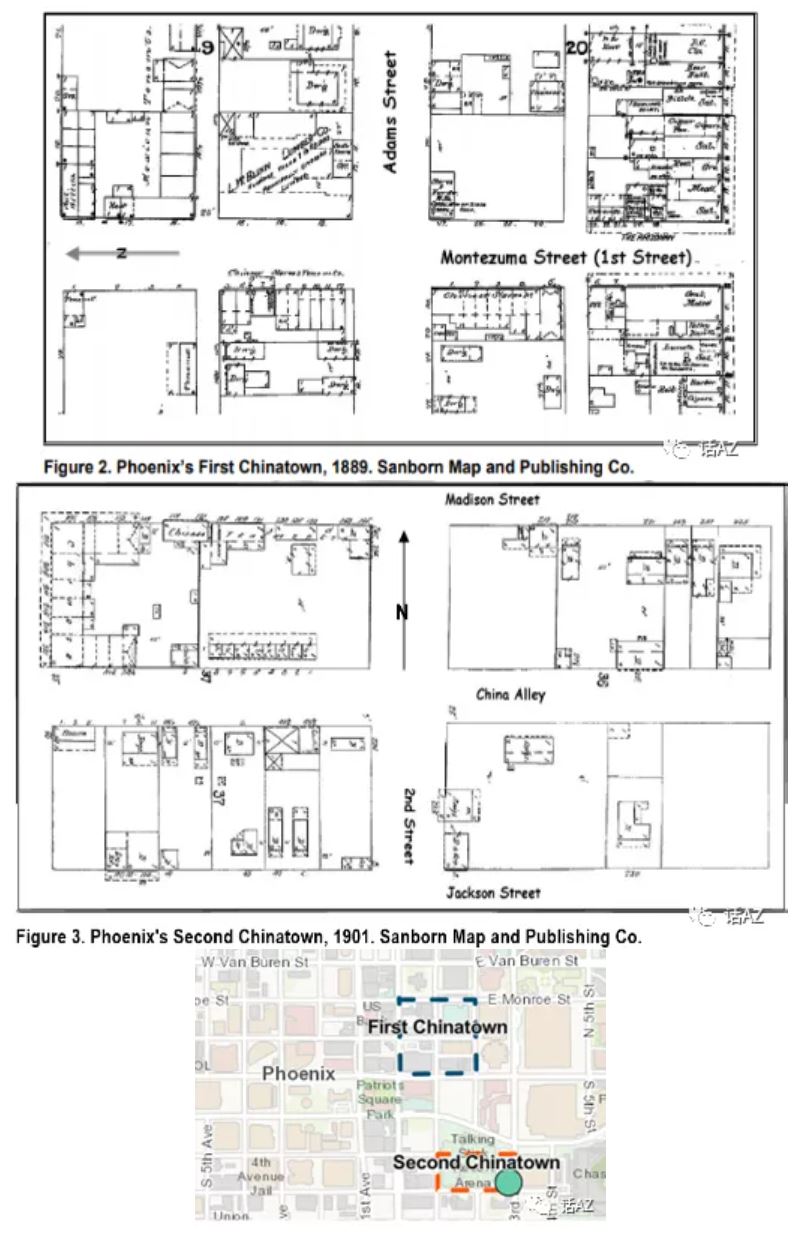
First Period Chinatown was a cluster of Chinese businesses and boarding houses located at 1st (then known as Montezuma) and Adams streets. Chinatown provided a separate space for Chinese immigrants to build community and a place where their businesses could grow.
At that time, Arizonans considered the Chinese to be unwelcome residents, but they did not have the same hatred towards the Chinese as the Californians, and complained more than threatened them. The most common complaints are against the laundry industry. In 1881, the Phoenix City Council declared "laundries" a public nuisance, later imposed a laundry license tax, and many people were charged with operating laundries without a license. The Phoenix Gazette often complained that Chinese controlled the laundry, restaurant and vegetable garden operations, but apparently no whites were willing to compete for these jobs.
However, by the early 1890s, white merchants launched a movement to move Chinatown out of the city's growing commercial district. At the time, Chinese immigrants were not allowed to own property, so they had no protection from eviction from rented buildings.
In 1895, white businessmen launched a movement to remove the "Chinese colony" and moved Chinatown away from the growing commercial district. The Chinese were threatened that Chinatown would be destroyed if they did not leave.
The second Chinatown in Phoenix is located along the three streets of Washington, Adams, and Van Buren, spanning 9 blocks. But some businesses remain in old Chinatown. In most buildings, such as restaurants, grocery stores, and laundromats, the first floor is used for business and the upper floors are dormitories.
By the 1930s, there was a Chinese grocery store on almost every block in Chinatown. There are more than 60 Chinese grocery stores. If they encounter competition from white merchants, the Chinese would rather move their stores to other places. They work hard and long hours, and the store is open more than 15 hours a day, all year round. By the late 1930s, after several generations of hard work, young people could enjoy a comfortable middle-class lifestyle. In 1945, due to the large-scale emigration of Chinese Americans, the second Chinatown in Phoenix almost completely disappeared. [119]
Map of Phoenix’s First Chinatown, 1889. Sanborn Map and Publishing Co., and map of Phoenix’s Second Chinatown.
"Chinatown" relics excavation and exhibition
In 1990, according to the municipal construction plan of Huanghuang City, a large comprehensive building complex that could accommodate stadiums, conference halls, etc. was to be built. At that time, many buildings, including the Ying Tuan Building built in the city in the early 1950s, were requisitioned and demolished by the government due to needs.
During the excavation of the foundation, many items were found, and they were immediately concluded to be relics or discarded items from Chinatown residents at that time. The government immediately issued a budget of NT$50,000 to cover expenses such as hiring archaeological experts and workers. These excavated relics and discarded objects fully demonstrate that in the earliest days, there were Chinese people in Huanghuang City, and the Chinese were part of the city and a part of the community. After excavation, it was determined that Chinatown at that time was located between First Street and Third Street, bounded by Madison Street and Jafferson Street to the north and south. It was the bustling area of Phoenix City's second Chinatown. In early 1890, the city's Chinatown population exceeded 200.
This batch of Chinatown cultural relics from the late 19th century unearthed immediately attracted great attention from the overseas Chinese community in Phoenix. Some elderly overseas Chinese and ethnic Chinese from the local Chinese Chamber of Commerce proposed to exhibit the cultural relics, which received strong support from all walks of life in the overseas Chinese community. A total of nearly 20,000 yuan was raised, and the combined funding from the municipal government and various parties reached more than 52,000 yuan.
After the completion of the stadium, in September 1992, the "Fine Chinatown Cultural Relics Exhibition" was opened for the first time in the east hall of the stadium. The unearthed cultural relics on display include two special counters such as ceramics, inkstones, teapots, and wine bottles, as well as documents of early Chinese returning to the United States, as well as photos and textbooks of the Feinian Chinese School in the early 20th century. Phenomenal Chinatown cultural relics have also been exhibited in many cities across the United States.
The cultural relics from that year have been collected by the museum after being exhibited. In view of this, in April 2016, the author and Deng Hongyue (pictured below), then Chairman of the Greater Phoenix Overseas Chinese Federation, went to the Phoenix Municipal Museum to conduct an investigation into the history of the Chinese ancestors of Alberta.
Museum Director Lindsey Vogel-Teeter received us personally. As for the museum, except for the exhibition of unearthed cultural relics held in the 1990s, no relevant Chinese groups have inquired about these histories in the past 30 years. The curator is very dedicated and has prepared many relevant documents, books, and photos for review. After that, he personally took us into the internal cultural relics collection room, allowing us to visit and take photos of the objects of the Chinese ancestors that were unearthed that year. We saw many unearthed cultural relics from that year inside the museum.
The cultural relics are placed in rows of counters. After opening, the cultural relics in the labeled plastic bags can be clearly seen at close range. Some parts can be touched with gloves, or moved to a place with special lighting for photography, and there are detailed introductions.
There are still about 2,000 Chinatown relics in the museum that need to be assembled, glued, classified, stored, and explained. Most of the relics are glass bottles, wine bottles, beverage bottles, milk bottles, and medicine bottles. Some of them are as old as 200 years old. The porcelain includes Chinese, English, Ink, and Honshu PIMA products. There are also incomplete Song Dynasty porcelain, also known as CELADON, and small items such as button earrings, bronze coins, etc.
Zhang Zhaohong and Deng Hongyue also went to the ASU university library to check and collect relevant information about the history of the Chinese in Phoenix City.
Sources and usage
This piece is republished or synchronized with permission and keeps a link back to the original source.