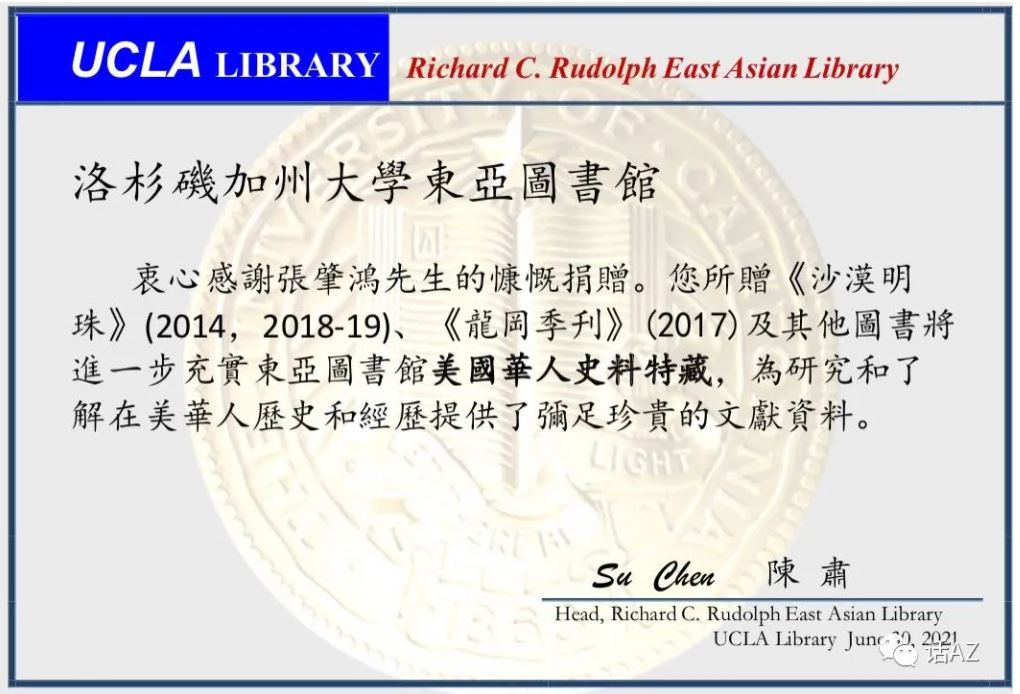
"Pearl of the Desert" | "Pearl of the Desert" was collected by the East Asian Library of the University of California, Los Angeles; History of Chinese in Arizona, United States (10)
"Pearl of the Desert" was collected by the East Asian Library of the University of California, Los Angeles. History of Chinese in Arizona, United States (10) Arizona Chinese Historical Association: Zhang Zhaohong United States...
"Pearl of the Desert" is collected by the East Asian Library of the University of California, Los Angeles.
Chinese History in Arizona, USA (10)
Arizona Chinese Historical Association: Zhang Zhaohong
The Changes of Chinatown in Tucson, Arizona, USA
(The author of this article is Li Yang) Ph.D., faculty member at Arizona State University, Vice President of the Arizona Chinese Historical Association.)
After the 1870s, the Pacific Railway across the North American continent was successfully built. The tens of thousands of Chinese imported from China for the construction of the railway immediately faced pressure to find new jobs, and many returned to the West Coast where Chinese people were concentrated to look for opportunities. But at that time, the U.S. economy was in a sluggish state and there were few job opportunities. European-American workers on the West Coast were very afraid of job competition from Chinese and were extremely repelled. In order to survive and develop, some Chinese moved to the east coast or the southwest, which was still under development at the time. Some of them entered Arizona and settled in Tucson, a border town near the border of the United States and Mexico.
The earliest Chinatown
The first people to enter Tucson are said to be three Chinese people named Huang. They opened a Chinese restaurant named "OK" in the urban area in the 1870s. Later, more Chinese came one after another.
The early Chinese who entered Tucson were workers who had lived and worked in the United States for many years. They had either built railroads or worked as miners and cooks in mining camps on the West Coast. In line with the national habit of hard work and frugality, even though the wages were low, many people had little savings, so within a few years after arriving in Tucson, they spent money to open laundries and snack bars in an attempt to make a living.
The railroad had not yet been opened at that time, and they probably crossed the Colorado River, the boundary river between California and Arizona, and entered Arizona by horse-drawn carriage, which was a popular means of transportation at the time. Some may have come to Tucson from Mexico.
At that time, Tucson changed hands again after experiencing the rule of Spanish colonists and Mexicans, and became a territory of the United States. The residents living in Tucson included indigenous Indians, Spanish-speaking Mexicans, and European Americans who ventured to the west.
During this period, Tucson still retained a strong Mexican style. Most of the residences were flat-roofed adobe buildings, lined up on the street, with a simple and rough style, not much different from other Mexican towns south of the US-Mexico border. The urban area of Tucson at that time was located on the east bank of the Santa Cruz River. It was developed on the original site of a ten-acre military fort first set up by Spanish colonists in 1776 and continued to be used by the Mexicans after 1821.
The earliest Chinese settlement was on the southwest side of this military fort. In 1879, there were about thirty people, all from "Sanyi" in Guangdong. On March 18, 1880, the Southern Pacific Railroad opened to Tucson. Another group of Chinese entered Tucson, and when the tracks continued to be laid and extended to the southeast, some chose to stay. In June 1880, the federal census counted 159 Chinese in Tucson, including two women. These new arrivals are all from the "Siyi" areas of Guangdong, with Taishan being the main group.
With the arrival of the "Siyi" people and gaining an absolute advantage in numbers, the "Sanyi" people who originally lived in the southwest of the Tucson military fort ruins gradually moved out. The earliest extant map of Tucson in 1883 that marked the Chinese settlement area shows that the southwest side of the Tucson military fort ruins and the east and west sides of the main street were the neighborhoods with the largest concentration of Chinese residents at that time, with laundries, restaurants, grocery stores, etc. This area was the earliest "Chinatown" in Tucson's history.
After the 20th century, the proportion of diasporas became larger and larger, so that the Chinese who stayed in "Chinatown" were basically old and single men. During this period, in addition to restaurants, laundries, and grocery stores, Chinese people also worked as domestic servants in European and American families, and as vegetable farmers who rented land to grow vegetables on the banks of the Santa Cruz River in Camp Lawwell, which was still a suburb at the time.
In addition to wholesale the vegetables grown by Chinese vegetable farmers to nearby military camps and local restaurants and grocery stores, there are also people driving horse-drawn carriages to sell them along the streets of Tucson. At this time, Tucson's Chinese society was basically dominated by "single men", and a small number of Chinese married Mexican women.
>Chinatown moves south
Since the 20th century, especially after Arizona became a federal state in 1912, Tucson has continued to expand and take on a completely new look. At this time, European Americans came from behind in various fields such as politics, economy, and culture, completely replacing the dominant position of Mexicans in Tucson. The two ethnic groups had gone from living together and marrying each other in the early days to becoming socially alienated. In terms of urban construction, two completely different communities appeared, bounded by Congress Street and Broadway.
With the formation of a new community pattern in Tucson, the Chinese who are politically and economically disadvantaged are also affected. The Chinese who originally lived in Chinatown north of Congress Street also began to move southward, driven by various forces. In 1910 and 1916, the original Chinese settlements were razed to the ground, and a women's club, city hall and other facilities with symbolic power were built on the old sites, marking the earliest "Chinatown" in Tucson's history.
After the new "Chinatown" moved south, the Chinese established more grocery stores in communities where Mexicans concentrated, mainly to serve Mexicans (according to the 1912 Pima County Business Yearbook, there were about 79 Chinese-operated stores in Tucson at this time, and three restaurants). By 1938, there were 60 Chinese grocery stores in Tucson (as well as 10 Chinese restaurants and two Chinese laundries). In 1950, the total number reached 114. In 1962, there were more than 130 schools (Tan Chengbo: "Special Issue of American Overseas Chinese School" published in 1962).
A wealthy business class emerged among the Chinese in Tucson, who were engaged in running grocery stores and restaurants. They served as heads of overseas Chinese groups such as clan associations, county guild halls, chambers of commerce or secret societies, and were the leaders of the Chinese overseas communities in Tucson.
After World War II, although the Chinese grocery store business in Tucson faced competition from national chain "supermarkets" and convenience stores, it still maintained a strong upward trend. It reached the peak of its development in the 1950s, with the total number of Chinese stores reaching 114.
In the 1960s, due to the "urban renewal" movement carried out in Tucson, Mexicans were forced to move out of the Hispanic neighborhoods south of Congress Street, and many government office buildings and other public buildings were built on the original sites.
Since the Chinese and Mexican residents of Tucson have long had a "symbiotic" relationship: Chinese grocery stores mainly provide services to Mexican residents, and Mexicans also rely on Chinese grocery stores to meet their daily needs. Therefore, Tucson's "urban renewal" destroyed the Mexican community in the lower city and also affected the Chinese. The grocery store business that the Chinese had worked hard for more than half a century was severely damaged and began to decline.
Chinatown disappeared
In 1968, Tucson implemented an urban reconstruction project, and "Chinatown" once again became a reconstruction area. "Chinatown" at this time mainly refers to an area between Main Street and Meyer Street where Chinese people are relatively concentrated. The adobe houses here are built in a row facing the street; the houses on all sides surround a courtyard and are laid out in a loop. In addition to being inhabited by twenty or thirty single elderly Chinese, it is also the office space of some overseas Chinese societies.
In 1972, the Tucson Convention Center was built on the original site of "Chinatown". Since then, there has never been a neighborhood in Tucson where Chinese residents are relatively concentrated. Tucson's "Chinatown" disappeared, but Tucson's Chinese did not disappear. After they moved out of the Mexican community, they integrated into the middle-class community, improved in all aspects, and opened a new chapter in history.
The Yingduan Chamber of Commerce and Industry was established in 1946 and dismantled in 1968
Sources and usage
This piece is republished or synchronized with permission and keeps a link back to the original source.