Desert Pearl | Chinese History of Arizona (9)
Arizona Historical Association: Zhang Zhaohong The second city to establish the state capital: Tucson In 1867, the Arizona state government was led by Price...
Arizona Historical Society: Zhaohong Zhang
The second city to establish a state capital: Tucson
In 1867, the Arizona state government moved from Prescott to Tucson.
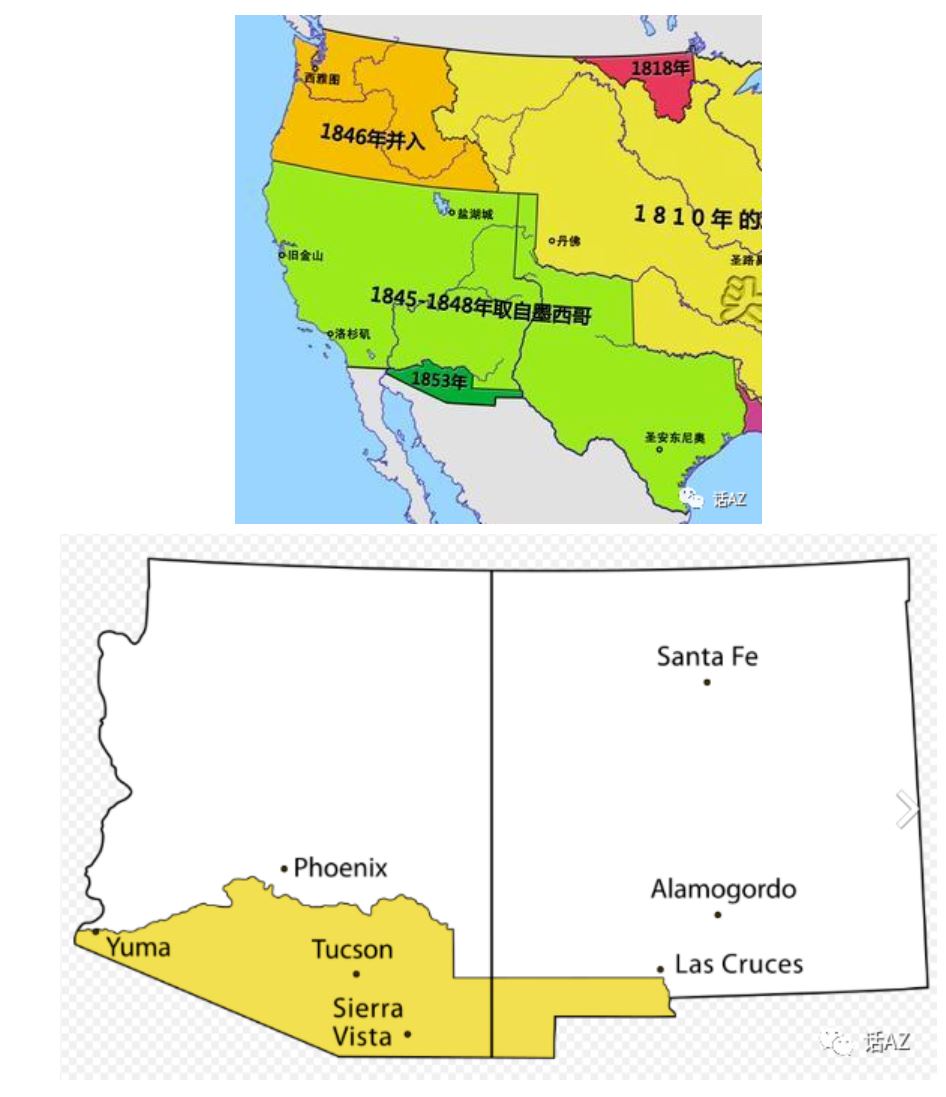
The territory of Tucson was purchased. In 1846, the Mexican-American War broke out, and the United States captured the capital of Mexico. In 1848, Mexico ceded a large area of territory (light green part in the picture). Part of the territory became the territory of Arizona, United States.
In 1853, the United States spent $10 million to purchase 77,000 square kilometers of land south of the Gila River in Mexico (the dark green part in the picture), which was crucial for the construction of railways. After the United States expanded its territory to the Pacific coast, the connection between its east and west coasts became a major issue related to the national destiny. Because it is blocked by the Rocky Mountains and the Sierra Nevada, it is difficult for people to enter the fertile and mineral-rich western coast. At the same time, it is difficult to transport a large number of high-quality natural resources in the west to the densely populated and vast market in the east. Building a second railway connecting the east and west has become an inevitable option. The area south of the Gila River is mainly a river valley with relatively flat terrain and continues into New Mexico, making it the best place to build the Southern Pacific Railway line in the United States. [91]
>The "Gadsden" land purchased in the name of American diplomat James Gadsden (Gadsden Purchase) is also a "golden area" where Chinese people are distributed. Many of the towns have a history of Chinese immigrants. We describe the information we collected as follows:
As mentioned earlier, in 1860, Yuma had the first Chinese, William. William Tching was a cook on a Colorado River ship. In the 1880s, there were 500 Chinese living in Tombstone, including Mr. and Mrs. "Along". [92]
In the Pima Indian reservation near Casa Grande, there was a Chinese businessman named Don Sing who ran a small grocery store. George Webb mentioned in his book "A Pima Remember": One afternoon, several Pimas natives were in the store looking for some kind of dessert. He picked up a strawberry compote and, to their surprise, said in plain Pima, "Go 'ep satoli we nags i-da," which means, "This is good. It has syrup on it." Don learned to speak the language as he grew up among the Pimas and Papagos natives. [93]
In Pima County data, a total of 850 Chinese (some with Spanish surnames) were listed as laborers. On all these pages it says "Railroad Worker". [94]
Before the Southern Pacific Railroad reached the town of Gila Bend, Arizona, three men named Huang left the railroad team and came to Tucson. They arrived in the late 1870s and established the "OK" restaurant on the southeast corner of Church Square and Mesilla Street. Use laundry baskets instead of cash registers and charge seventy-five cents per meal. [95]
When the Southern Pacific Railroad arrived in Tucson on March 20, 1880, Tucson had become the largest Chinese settlement in the territory. The 1880 U.S. Census listed 1,630 Chinese residents, 1,153 of whom lived in Pima County, 159 of whom lived in Tucson. [96]
>Railway cook Chan Tin-Wo participated in political activities. In the 1880 Ta Kung Pao, no Chinese were recorded voting, and in the 1882 Pima County record books, Chan Tin-Wo was the only person elected. This indicates that he had become a naturalized U.S. citizen the previous year. [97]
Chinese Lee Wee-Kuan moved to Arizona from northern Mexico and ran a grocery store outside Tucson. He chose to settle in the Spanish-speaking village of Yaquis based on his experience in northern Mexico and his ability to speak English. [98]
Lee Kwong and Lai Ngan were the first Chinese family to settle in Nogales, Arizona. Not wanting her children to grow up in Mexico, Lai Ngan came to the United States in 1903 and settled in Nogales, Arizona. She rented a large house there for $25 a month. She also ran another small grocery store. Li Guang sells lottery tickets in the morning, noon and evening. They are the only Chinese family in Nogales. [99]
>Chinese Lee Wee Kwon is a successful businessman among Chinese immigrants. He played an important role in the development and growth of Chinese businesses in Tucson. Dr. Yang Li of Arizona State University mentioned this history in a speech in May 2021. We will mention this in a subsequent article.
In Benson, Arizona, there is Chinese immigrant Deng Suiye (Hi Wo) and his family. In 1896, Tang Suiye purchased Roger Brothers' store and changed its name to "Hi Wo" grocery store. The store is an important part of Benson's history. During the Depression, the Duns extended credit to ranchers, farmers and others when few other businesses were willing to do so. In the early 1930s, grocery stores were robbed many times. Deng Suiye died in December 1931 at the age of 74. Mrs. Deng Suiye passed away in April 1932. In 1933, Deng's son died of an accidental gunshot wound at the age of 42. One of Deng's two daughters continued to run the family business, and Deng's Hi Wo grocery store became a part of growing up with Benson for nearly a century from its opening in 1896 until its eventual closing in 1989. Many old local families still speak highly of the Hi Wo family and store. [100]
>The Tucson Chinese Cultural Center purchased a large number of documents and cultural relics from the Deng (Hi Wo) family. Georgetown University's Katherine Benton-Cohen tells the legendary story of Benson's only Chinese family through artifacts, highlighting their importance to southern Arizona communities throughout the 20th century and even today. TCCC Presents produced two short films about the Chinese family based on the artifacts, providing more context for the diverse culture of Arizona's southern border region.
There was also a German Henry Buehman in Tucson. He came to the Arizona Territory in 1873 and bought a photography studio in Tucson. In 1893, due to the introduction of the GEARY Law, long lines of Chinese came to his house to have their photos taken for ID cards to avoid being jailed and deported. After his death, his son Albert inherited the photo studio in 1912. They donated hundreds of photos of Chinese people to the Asian Historical Society. This set of donations is called the "Albert and Henry Buehman Collection." [101]
Sources and usage
This piece is republished or synchronized with permission and keeps a link back to the original source.