>Desert Pearl | History of the Chinese in Arizona, USA (7)
Arizona Historical Association: Zhang Zhaohong Chapter 3: Three cities that established state governments The capital of Arizona has been moved three times. In 1864, Prairie...
Arizona Historical Association: Zhang Zhaohong
Chapter 3: Three cities that established state governments
> The capital of Arizona has been moved three times. In 1864, Prescott was designated the capital of the Arizona Territory. In 1867, state government moved to Tucson. Ten years later, in 1877, state government moved back to Prescott. Since 1889, Phoenix has been the seat of Arizona's state government. [74]
>The first city to establish a capital: Prescott
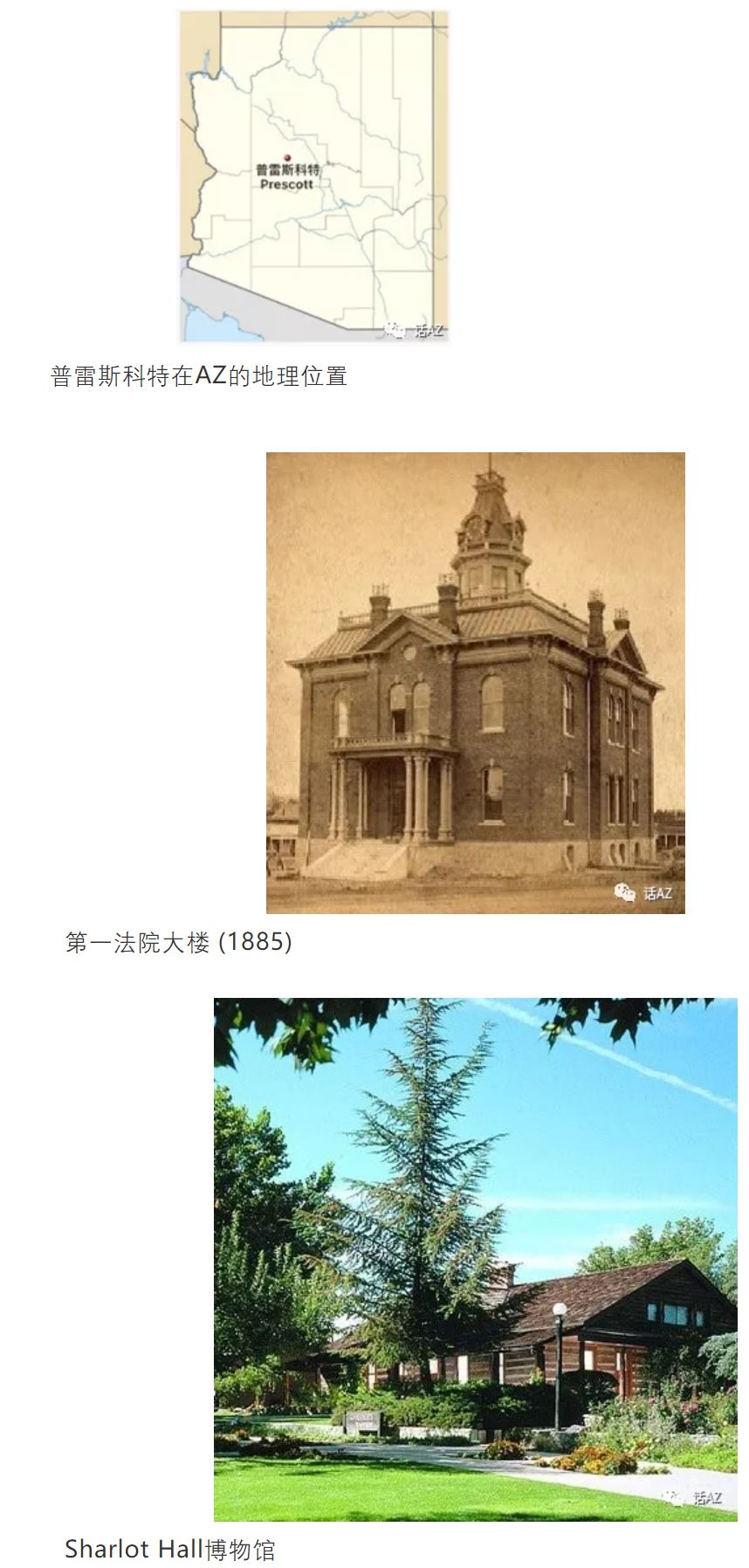
New expats may not be familiar with Prescott. The author has visited this small town. There are rolling mountains and vast pastures, clear streams and blue lakes. The temperature in hot summer is 20 degrees (Fahrenheit) lower than that of Phoenix. It is a good place for leisure and escape.
Prescott is a city rich in history. In the Sharlot Hall Museum, there is a cultural center with social and natural features, 11 new and old buildings and historical sites, and a cultural relic collection and preservation research center. Annual rotating and permanent exhibitions present history and culture from the Pleistocene Epoch (14,000 years ago) to the present.
The United States completed the national railway network in the 19th century and the national highway network in the 20th century. So now to go from Phoenix to Prescott, you only need to transfer from I-17 to Interstate 69, and it will take about two hours by car.
In the 1860s, gold was discovered south and east of Prescott, and later in the Antelope Mountains. During the Civil War in 1863, the United States Congress passed legislation establishing the Arizona Territory. Due to the great losses caused by the war and the federal government's concern over the Arizona Territory's mineral resources, Prescott was designated as the first capital of the Arizona Territory on May 30, 1864. [75]
>The name Prescott was given in memory of the historian William Hickling Prescott.
Prescott is also the county seat of Yavapai and was a frontier town during its territorial days, often associated with crime, riots, and shootings. Before the influx of others, the Yavapai had an indigenous population that had occupied the area for hundreds of years.
Later, adventurers, gold miners, farmers, and ranchers sought to acquire land in Prescott through the federal Homestead Act. Businessmen, lawyers and others seeking new opportunities also came here. Saloons and bars were once dotted on both sides of Whiskey Road. The Western Gold Rush at that time turned this originally unknown and quiet town into the center of a stage that included cowboys, gamblers, promiscuous women, gunfights, hangovers, sudden wealth, bankruptcy and other dramatic elements. [76]
In July 1887, the Prescott and Phoenix Railway opened to traffic. By 1895, the Santa Fe Railroad connected local mining areas to the Southern Pacific Line, spurring economic and commercial development and leading to the establishment of new dry goods stores and mining supply businesses. Communications and utilities grew as transportation developed, with the construction of an electric light factory in 1889 and the telephone shortly thereafter. That same year, the capital of Arizona moved to Phoenix, and despite the political losses, Prescott continued to prosper.
On July 14, 1900, a catastrophic fire destroyed four and a half blocks of downtown Prescott, and commercial development changed dramatically. Twelve hotels and 20 commercial establishments disappeared. After the fire, citizens saw the disaster as an opportunity to replace the old wooden buildings common in the downtown area with more permanent concrete, masonry buildings, and paved streets with cement, replacing the dusty roads of the 1800s. The fire stimulated social development and progress in the public realm.
In 1920, Prescott's population was approximately 5,000. One hundred years later, in 2019, the population was 42,785, and less than 1.5% of the population was Asian.
The Chinese in Prescott
In 1868, the Chinese were already mining in Prescott. It was reported that on June 13, 1868, at Vulture, near Wickenburg, an article in a miner's publication stated that more than twenty Chinese pioneers were employed there to complete most of the work, and many people felt their hearts tremble when gold or silver mines were discovered. [77]
>After the completion of the Central Pacific Railroad in 1869, some of the Chinese who settled in Prescott may have been workers laid off from the Central Railroad in 1869. They worked as crop producers, miners, chefs in saloons and restaurants, domestic servants, laundromat owners, and even dealers.
In the article "Chinese Sojourners in the Prescott Area" written by Florence C. Lister and Robert H. Lister, it is mentioned that there was a Chinese in Prescott, and his name was "Quong Clong Gin" (Chinese transliteration: Jin Guangchang). [78]
The Chinese "Jin Guangchang" was also mentioned in the book "The History of Chinese Immigrants into the Arizona Region: Pioneer Culture in the American West" written by Rhonda TintleI. There is evidence that "Quong Clong Gin" is in Block 13 on the 1882.7 map of Prescott, which lists Quong Clong Gin as the owner of lot 10. [79]
Between 1870-1880, the houses and businesses of Prescott Chinese residents were concentrated on Granite Street. The Chinese were diligent in their search for work. They soon became property owners and were big savers. For example, there was a Chinese businessman named Sam Lee who purchased a farm in Yavapai County. Li Shan would also own a restaurant, but was eventually murdered by another Chinese business competitor. [80]
Sam Lee was also a notable figure in Sharlot. Hall Archives, U.S. District Court Records 1864-1912, National Archives and Pacific Records Administration (Laguna Niguel), etc. [81] Other Chinese opened restaurants, laundries, shops, or became farmers here. (To be continued)
Photos from the Internet:
75,76. https://www.prescott.org/history.html. 77, https://parentseyes.arizona.edu/node/376. 78, Florence C. Lister and Robert H. Lister: Chinese Sojourners in Territorial Prescott (Spring, 1989). 79, A HISTORY OF CHINESE IMMIGRATION INTO ARIZONA TERRITORY: AFRONTIER CULTURE IN THE AMERICAN WEST. 80,81, RHONDA TINTLE: A History of Chinese Immigration to Arizona P.4, P.39
Sources and usage
This piece is republished or synchronized with permission and keeps a link back to the original source.