Chinese: Explore the ancient ways of making characters, find the original meaning of Chinese characters, and inherit Chinese culture article cover image
News/Community Wire/Archive/Jan 22, 2020
Legacy archive / noindex

Chinese: Explore the ancient ways of making characters, find the original meaning of Chinese characters, and inherit Chinese culture

Republished with permission

January 18, 2020, the 24th of the twelfth lunar month, approaching the Spring Festival, at 6 p.m. that day, hosted by the China Chinese Language Education Foundation and the National Association of Chinese Schools, Alberta is now...

Local families

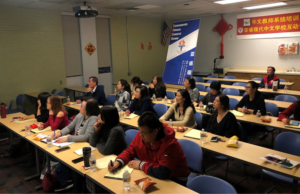
On January 18, 2020, the 24th day of the twelfth lunar month, approaching the Spring Festival, at 6 p.m. that day, an interactive classroom for systematic training of Chinese teachers, sponsored by the China Chinese Education Foundation and the National Association of Chinese Schools, and hosted by the Alberta Modern Chinese School, was grandly held. The title of this training is "Teaching Chinese Characters in Chinese Classrooms" and was delivered by Professor Meng Dehong, Director of the Department of Chinese as a Foreign Language at Beijing Foreign Studies University. Director and Secretary General of the National Association of Chinese Schools, Principal Yang Yilun and Chairman Tao Shicheng of our school participated in the entire training. An Ran, the vice-principal of teaching at Modern Chinese School, Zeng Yinghua, the vice-principal of student affairs, all Chinese teachers, other Chinese teachers and Chinese teaching enthusiasts in the community gathered together to listen to Professor Meng's wonderful analysis. This training was also broadcast live online by the China Chinese Education Foundation. Hundreds of member Chinese schools across the United States of the National Chinese Schools Association organized teachers to watch the live broadcast.

>Professor Meng made a clear statement, pointing out the origins and connections of Chinese characters, culture, and civilization. On the occasion of the New Year, Professor Meng first used the word "spring" in bronze inscriptions as an example to explain the three components of the character spring, the meaning of each part, and the meaning of the character "spring". He also explained the "knowing" character creation method in an easy-to-understand manner. Then he took the character "白" and "edge" as examples to explain the character creation methods of "phonetic characters", "pictographic characters", and "zhishi characters" respectively. At this point, Professor Meng has vividly and intuitively explained the four methods of character creation.

> One of the characteristics of Chinese characters, and the biggest difference between Chinese characters and alphabetic characters, is that each character is a complex of form, sound and meaning. The main body of the characters such as Bo, Bai, Bo, and Bai is "bai"; the main body of the characters such as Zhu, Zhu, Zhu, and Zhu is "zhe". "Bai" means "big", and "Zhe" means "attachment, attachment". Therefore, the meaning of Chinese characters with them as the main body must have the original meaning of the main character. In addition, Chinese characters also have the characteristic of "similar sounds and similar meanings". For example: appearance, image, fragrance, sound, thought, enjoyment, etc., respectively express similar experiences in vision, taste, smell, hearing, psychology and other aspects. The history of human society will inevitably leave traces in words. Professor Meng used the characters "paper" and "zhu" as examples to interpret that our ancestors had a history of writing words on "grass"; taking "wife" as an example, it showed that our ancestors' marriages were based on robbing brides as the main method, and Western culture also has similar records of word creation and historical origins; he also used the word "read" as an example to explain how we inspected armed forces in ancient times, etc. All the teachers at the scene were firmly attracted by Professor Meng's erudite explanations and were deeply immersed in the vast and profound ocean of knowledge about the Chinese language. The 60 minutes passed quickly. Everyone felt that there was still something to learn and hoped to have the opportunity to listen to Professor Meng's lectures again. Professor Meng started with the Chinese characters we often use in our daily lives, analyzed their creation methods, explored their original meanings, and profoundly revealed the functions of Chinese characters in terms of word expression and cultural inheritance. It provides a good way for us to learn, understand and teach Chinese characters and improve students' interest in learning. Thanks to the China Chinese Language Education Foundation and the National Association of Chinese Schools for providing Chinese educators in the United States with a rare opportunity to interact with masters of Chinese language and literature. Thanks to President Xing Bin and Minister Xu Lanwei of the National Association of Chinese Schools for their care and guidance for this event. Thanks to the volunteers of the Modern Chinese School in Alberta for planning and arranging this lecture a month ago and ensuring the success of the interactive class. Let us look forward to the next exciting training!

(Written by: Modern Chinese School Chinese teacher Xu Yijun Photography: Modern Chinese School Talent Class Teaching and Research Team Leader Mao Erlu, Chinese teacher Xu Yijun)

Sources and usage

This piece is republished or synchronized with permission and keeps a link back to the original source.

Editorial tags

Community WireArchiveRepublished with permission