Cui Zengqi: Hometown Trip (2) - Shanghai Trip (Photo)
Cui Zengqi: Hometown Trip (2) - Shanghai Trip (Photo) At 10 pm on December 30, our plane arrived at Shanghai Pudong Airport. A friend from the travel agency called out...
Our plane arrived at Shanghai Pudong Airport at 10pm on December 30. It was already 12pm when our friend from the travel agency called a taxi to take us to the hotel. He told us to have breakfast at 6:30 the next morning and set off at 7:45. This is how the intense trip began. Shanghai is a city that I am deeply attached to. Not long after I was born, my mother hugged me and set foot on this land. During the eight years of the Anti-Japanese War, I fled to Yunnan with my parents to avoid Japanese aggression. In 1945, I returned to Shanghai after the victory of the Anti-Japanese War. I spent my entire life in this city from elementary school to high school graduation. The patriotic enthusiasm and grand ambitions of my youth prompted me to leave the prosperous Shanghai and start a journey of exploring life. It took decades to realize how precious the lost Shanghai registered residence was. Even so, Shanghai and I have always been inextricably linked. When my father was alive, he had been working in Shanghai, and I often visited him. After my mother passed away, she was buried in Shanghai Hongqiao Cemetery. In the first thirty years after liberation, there were not many obvious changes in Shanghai's architecture. It was just that people's hearts turned bad during the Cultural Revolution. Shanghainese are bullying and often look down upon those who cannot speak Shanghainese. Once, when I was on a business trip to Shanghai, someone actually bullied me. I said back to him unceremoniously, "I've beaten everyone in Shanghai, but not even a little red guy." When he heard that I had some background, he shrank back. After the reform and opening up, Deng Xiaoping gave an instruction and the development of Pudong kicked off. Thirty years later, a new Shanghai was built in Pudong, which used to be a land of farmland and wilderness, at a speed unparalleled in the world. The folk saying "I would rather have a bed in Puxi than a room in Pudong" is still in my ears, and Shanghai's housing prices have reached the top of the world. I was fortunate enough to have contributed to the development of Shanghai. I participated in the formulation of the first shield tunnel construction plan across the Huangpu River and the construction of a high-rise building in Pudong, which is now used by the Holiday Inn. As a jury member of the National Science and Technology Progress Award, he also cast a sacred vote for the Oriental Pearl TV Tower, Nanpu Bridge and Huangpu River Tunnel, which won the first prize of the National Science and Technology Progress Award three times in Shanghai in the 1980s. Starting from Pudong, there are countless high-rise buildings along the way. As the car passes the Nanpu Bridge, on the left is the Oriental Pearl TV Tower and the red China Pavilion of the World Expo, on the right is the towering 88-story Shanghai Jinmao Tower, and in front of you is the beautiful view of the Bund built in Shanghai by Western countries in the early 20th century. This is such a spectacular and beautiful picture, and it also shows people the changes that Shanghai has experienced. Over the past century, the Huangpu River has witnessed everything that has happened. I remember the old Shanghai, the 24-story "International Hotel" was a landmark building in Shanghai. We often say that when we looked up at the International Hotel on Nanjing Road, our hat fell to the ground. When Shanghai was first liberated, Kuomintang planes bombed Shanghai every day. The Communist Party did not have anti-aircraft guns at that time, so they set up machine guns on the roof of the International Hotel to shoot down planes. Today, the International Hotel looks like a little old man among the many buildings, having long lost its former glory. In the past, you had to take a ferry from Puxi to Pudong. Now there are five bridges and three tunnels erected on the Huangpu River. Just when I fell into those fascinating memories, the car arrived at the first tourist attraction, the City God Temple. The Chenghuang Temple is a place where people burn incense and worship Buddha. Kind-hearted Chinese people always look forward to a peaceful and stable life, and always live with the hope that each year will get better and better, and each generation will become stronger than each generation. The ancient saying "You must not have the intention to harm others, and you must not have the intention to guard against others" is people's philosophy of life. Therefore, some people worry that as China becomes more powerful, there will be a Yellow Peril. I think this is completely impossible and does not conform to the basic cultural attributes of the Chinese nation. The City God's Temple is a Taoist holy place, and the City God is the god who protects the city. The temple is not dedicated to Bodhisattvas, but to local officials who have been praised by the people for their political achievements in protecting the city or doing things for the people. They are real people who have made outstanding contributions to local development. The Shanghai City God's Temple is dedicated to Huo Guang, a military general in the Han Dynasty, and Qin Yubo, a local official in Shanghai in the Ming Dynasty. When I was a child, my grandmother always took me to the Chenghuang Temple every year to burn incense and kowtow, asking the Bodhisattva to bless me with good health and academic progress. What I was most interested in was buying pear candy, five-spice beans, and eating stinky dried tofu and Ningbo glutinous rice dumplings. Times have developed, and although these small commodities are still there, Nanxiang Xiaolongbao and the "Green Wave Gallery" that Clinton visited during his visit to China are people's first choice. Even so, the belief of seeking the blessing of Bodhisattva for everything has been firmly rooted in my heart. When I was in school, whenever I didn't feel confident before an exam, I would go to the small temple near the school and kowtow to ask for a sign. Throughout my life, I believed in science and did not believe in the existence of Bodhisattva. I thought it was a kind of spiritual sustenance for kind people. But every time I walk into the smoke-filled hall, I can't help but silently pray to the Bodhisattva for blessing, and this time is no exception.
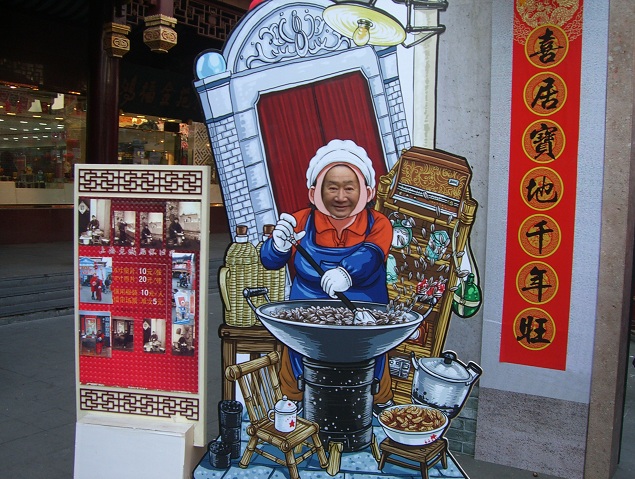
Roasted Chestnuts with Sugar in the City God's Temple The second visiting point is the Shanghai Museum, which is located in the prime location of Shanghai, in the center of People's Square. This was the racecourse of the British in the past, a place where wealthy people went for entertainment and gambling. I remember that when the Shanghai Museum was built in 1952, it was in the Jockey Club building. The new museum was built at this location in 1996. It is a square building covered by a dome, symbolizing China’s ancient concept of a round sky and a round earth. The museum collects many bronzes, pottery products, fine paintings and calligraphy from past dynasties, as well as ancient coins, seals, etc. What impressed me most was the Ming Dynasty furniture collected by Chen Mengjia. Everyone of our generation has heard the name Chen Mengjia. He was a well-known archaeologist. He returned to the motherland from the United States with patriotic enthusiasm in the early days of liberation. Unfortunately, in 1957, he was labeled as a rightist because he raised objections to the writing reform. The upright intellectual could not survive the Cultural Revolution, but the ignorant young Red Guards treated him like a monkey and passed away. Seeing the preserved antique Ming Dynasty scholarly family hall, I feel how hard-won this is. During the ten years of catastrophe, how many people's precious youth was wasted in vain, how many people died in unknown circumstances, and how many precious cultural relics were destroyed. As far as our family is concerned, we are an ordinary middle-class family. Some calligraphy and paintings were passed down from my great-grandfather. When the Japanese invaded China, my grandfather still kept them intact. During the Cultural Revolution, our house was ransacked and all of them were destroyed. There used to be a mahogany square table and four Taishi chairs in my living room. The backrests of each chair were inlaid with marble. Although these are not necessarily cultural relics, even these things did not escape the fate of the Cultural Revolution. What’s even more ridiculous is that in that era of confusion between right and wrong, my little sister who was not very sensible at home told me that he chopped the chairs into firewood and burned them, so that the family would be at peace. There were tens of millions of stories like this happening in China back then. These memories make me feel even more hard-earned when I see the exhibits in the museum. They have survived wars and catastrophes. (To be continued)
Well-preserved celadon vessels
Early banknotes
Sources and usage
This piece is republished or synchronized with permission and keeps a link back to the original source.