I hope Chinese school students will perform "Mulan Goes Out" on stage and behind the scenes
I hope Chinese school students will perform "Mulan Goes Out" on stage and behind the scenes - and write poems and inscriptions for Dr. Chen Pu to praise the performance...
- Also write poems and inscriptions for Dr. Chen Pu to praise the performance and praise him
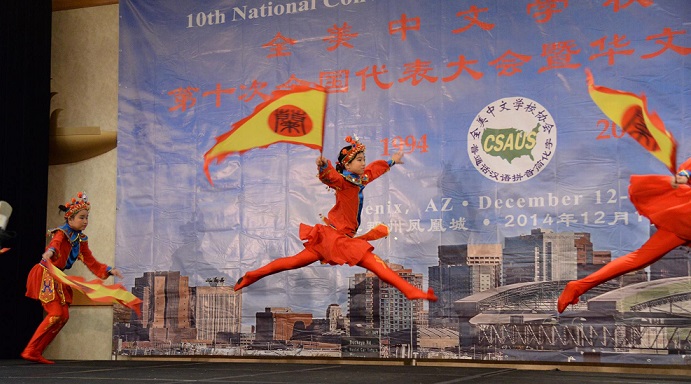
Phoenix PEN Shuai Zhiruo In May 2014, in preparation for the performance at the 10th National Congress of the National Association of Chinese Schools, the heads of five Chinese schools in this city met with me to discuss the basic tone and requirements of the program. At the meeting, it was decided that the program should reflect the students’ achievements in learning Chinese language and culture. Zhou Qing, the chairman of Hope Chinese School, and Tian Lin, the principal, all had in mind the idea of adapting and rehearsing the "Mulan Goes Out" dance drama and enhancing the language performance; this is what the program's choreographer Jiang Lin recently told me. On the evening of December 13, 2014, after the awards ceremony at the National Convention of the National Association of Chinese Schools, the first program performed was "Mulan Goes Out" by Hope Chinese Schools. It started with nearly twenty students reciting "Mulan's Song" in unison. More than a dozen ancient female warriors in battle uniforms and heroic figures jumped out one by one amidst the rapid music. In an instant, the venue, which was originally bustling with laughter, suddenly disappeared. After quieting down, everyone was fascinated; the 5-minute performance had a unique form, closely linked links, complete plot, and full content. The Chinese education professionals present came from all over the United States and even the Chinese education department of China. They were all well-informed, but after seeing this show, everyone was full of praise and marveled that a weekend school that mainly teaches Chinese language could produce such an exciting and shocking dance drama!
Photo description: Performed at the National Convention of the National Association of Chinese Schools in December 2014 (Photography by Jiang Peikun)
In early February, the person in charge of Hope Chinese School informed that "Mulan Goes Out" will be performed in the grand theater of the Chandler Art Center. The program has been strengthened, the number of people has increased, and the stage has become larger, attracting me to rush to the theater to see it in person. On the day of the performance on February 15, I saw that not only the students in the dance group were wearing special costumes, but also the students in the recitation team were wearing specially ordered traditional costumes containing Chinese elements. I really admired the Chinese school for paying so much attention to children's activities.
"Mulan Goes to the Expedition" was performed at the National Convention of the National Association of Chinese Schools in December 2014 (Photography by Jiang Peikun)
The performance started, and I hope that the Chinese school's "Mulan Goes to the Go" will be the first to make a grand appearance. In the melodious music, twenty-four male and female students recited the first paragraph of "Mulan Ci" with standard and clear pronunciation, explaining the background of the national heroine's expedition on her father's behalf; then fast music sounded, gongs and drums sounded urgently, indicating that the military situation was urgent and the war was urgent! The recitation started again: "Buying horses in the East Market..." The four sentences were laid out to describe Mulan's nervous purchase of war horses and harnesses. Then, amid the passionate music, twelve ancient soldiers led by Mulan strode out, whipped their horses, flew over pass after pass, and went straight to the battlefield. The music slowed down again, and the recitations started again: "The water of the Yellow River roars and splashes" and "The barbarians in Yanshan chirp and chirp." The soldiers on the field showed their tenderness of missing their homes and relatives. Then, amid the excitement of the music, the soldiers returned in triumph; the music became heavier, and the recitation began again: "Generals die in a hundred battles, and heroes return in ten years." This describes the fierce battle, the protracted war, and the tragedy of the soldiers. In the last section, Mulan used a neat action of taking off her hat to restore her female body; the recitation started again: "The male rabbit's feet are twitching, and the female rabbit's eyes are blurred; two rabbits are walking next to each other, how can they tell whether I am a male or a female?" The children ended with a metaphorical sentence to describe the mystery of Mulan's disguise as a man, which is not easy to be discovered.
"Mulan Goes to the Battle" performed at Chandler Center for the Arts (Photography by Shuai Zhiruo) This group of thirty-six children aged 7-15 used recitation and dance to perform a popular legendary story in Chinese history in just 6 minutes. Not only were the performances skillful and the form unique, the most valuable thing was that it was a spiritually uplifting program, full of family affection and nostalgia, praising traditional Chinese virtues, embodying the spirit of resisting foreign enemies and defending the country. It was a program with a healthy spiritual core. I think the teachers who coach them, the parents who support them, and the teachers who pay attention to them are not only happy to see the young children perform such a magnificent performance, but may also be moved to tears.
"Mulan Goes Out" was performed at the Chandler Art Center and recited by a group of students (photographed by Professor Ding Yunyan). This dance poem was choreographed by Jiang Lin, an art teacher at Hope Chinese School. Teacher Jiang Lin is also a member of the Asia-Pacific Wind Band Association and an image training teacher; she once formed China's first female migrant work band, and has planned evening parties and dance choreography for many years; Teacher Jiang Lin has taught dance for many years, and her teaching is patient and meticulous, and she has a strong affinity. The recitation part of the program was tutored by Mr. Shi Jingwei, a Chinese teacher at Hope Chinese School. Mr. Shi graduated from Renmin University and once worked at CCTV. He speaks fluent Mandarin. After the performance, I talked with the two teachers and listened to them talk about the arrangement ideas and the tutoring process. I felt the hard work of the teachers and deeply admired the teachers' creative ideas and flexibility in applying pedagogical principles. The recital part of "Mulan's Expedition" selected four of the six paragraphs of "Mulan's Ci", and selected and edited very appropriate music, which strongly enhanced the plot. Teacher Jiang said that she had rehearsed a "Mulan" dance in her dance class before. Her teaching philosophy is to let children not only learn dance, but also let them understand Chinese culture through dance. The subject matter of "Mulan" is very good, and according to current popular words, it is full of positive energy. The original intention of choreographing "Mulan's Expedition" is to create a large-scale dance drama with plot and content based on the dances that have been rehearsed. The two teachers said that with the strong cooperation of parents, they showed the children "Mulan" videos and animations to help them understand the plot; Teacher Shi added pinyin to the recited words to help the children read and memorize; they explained to the students that "chirp again chirp" is the sound of ancient looms; "I have no elder son", grandpa is the father; because China has a large area and many local languages, some places call father daddy and mother mother. So by learning recitation and performance, the children not only memorized the "Mulan Ci", but also learned about Chinese culture. Some students were reluctant at first, but later learned the story of Mulan and found it interesting. Later, they participated in group rehearsals and performances and learned more about the content of Mulan's poem. They were also very proud, firstly, that there was such a heroine in ancient China, and secondly, that their performances were so praised. It is hoped that the Chinese school's arrangement of the performance "Mulan's Expedition" will not only successfully create an excellent play for children, but also an example of the successful application of advanced educational theories. The modern educational theory of "learning by doing" advocated by the famous American educator Dewey is to make full use of children's play instinct and encourage students to learn through activities. The "immersion" teaching method currently used in language teaching classes in mainstream schools also emphasizes entering a language learning environment. The rehearsal and performance process of "Mulan's Expedition" is a very effective practical teaching that uses the above educational theory flexibly. I believe that the students' rehearsal and performance of "Mulan Goes Out" will have a very positive and effective promotion for their learning of Chinese language and culture. It will even leave long-lasting beautiful memories in their minds and have a subtle and good influence on their growth; at a young age Students started with simple concepts such as "loom", "grandpa" and "women disguised as men". I believe they will have the opportunity to learn deeper content in "Mulan Ci" in the future and will continue to deepen their understanding of Chinese culture. This is also in line with the "spiral upward" learning principle. Attached is the recording of "Mulan Goes to the Battle". Even if you only listen to the music and recitation of this program, you will feel the strong shock. The author wrote this article in one breath while listening to the recording of this program. I have a strong preference for "Mulan Ci". Attached are the links to my articles on "Mulan Ci" in recent years on the "Sunbird" website: Phoenix City Wen Ruo: Chinese Spiritual National Soul - Watching the "Mulan" Kung Fu Stage Play http://www.sunbirdarizona.com/News-Detail.asp?keyno=4436 [Phoenix PEN] Wen Ruo: Reciting "Mulan Ci" http://www.sunbirdarizona.com/News-Detail.asp?keyno=5112 (Written on March 1, 2015)
Author: Shuai Zhiruo, majored in physics, education and psychology at Normal University. Went to Europe to study in the late 1980s. In the 1990s, he studied modern Chinese literature and ancient Chinese at the University of California and Arizona State University. For more than ten years, he has taught Chinese at Hope Chinese School, serving as principal, board member, and board consultant; for many years, he has served as quarterly editor, association director, vice president, and president of the National Association of Chinese Schools, and is now the honorary president of the National Association of Chinese Schools; in 2014, he was awarded the honor of "Outstanding Person in Overseas Chinese Education" at the World Chinese Education Conference. Growing up in a big family with a strong literary style, I have been deeply influenced by literature, art, history and geography. After going abroad, I have always observed the world with curiosity in my rich travel life for many years, and recorded, read and written with a studious heart. My works are mainly narratives and essays, and a large number of articles, especially educational articles, have been published in newspapers and literary journals in China and the United States. More than ten years ago, he initiated the establishment of "Phoenix PEN" with fellow literary friends, and is now the president of the North American "Phoenix PEN" of the World Chinese Writers Association.
Dr. Chen Pu's poetry and calligraphy: Watching "Mulan Goes to the Battle" The iron robes and gold flags are flying, and the poems recite Mulan's energy into the clouds. Mo Dao's hometown is hundreds of thousands of miles away, and there are descendants who will pass on the salary. – Yiwei’s thoughts on watching the performance of “Mulan’s Expedition” during the New Year. ~ Apu
>Chen Pu, pen name Apu. Born in Fuzhou, China. Graduated from Fujian Normal University in 1977, bachelor's and master's degrees in English. After graduating in 1982, he stayed in the department to teach. In 1989, he studied at Northern Arizona University in the United States and received a master's degree in applied linguistics and a doctorate in educational leadership. He has worked in universities, middle schools, primary schools and the Arizona Department of Education. He once served as director of the Arizona Principals Academy in the state Department of Education, editor-in-chief of "APA Newsletter", director of the Research & Evaluation Department of the Creighton School District, education consultant of the Roosevelt School District, principal, chairman and teacher of a Chinese school. Currently teaching in Arizona, and serving as a visiting professor at Fujian Normal University, Fuzhou University and other universities. Inheriting court training at a young age will benefit you throughout your life. Especially interested in literature, history, philosophy, art and nature. Literary creation focuses on Chinese classical poetry, prose and English poetry. His works are scattered in newspapers and book collections, such as: "World Peace Poetry Collection", "Centennial Quatrain Collection", "Chinese Poetry Dictionary", "Tuopai Cup" National Day 50th Anniversary Competition (Second Prize), THE COLORS OF LIFE-The International Library of Poetry, The International WHO’s WHO IN POETRY, etc. Most of the Chinese poems he creates are based on classical rhythmic works, and all the materials used are extracted from his insights into life experiences and reading experiences. He first studied calligraphy from Liu, and then studied calligraphy from Wang Yan and Ou Chu. Later, he studied calligraphy from Wei Li and Su Huangmi. Calligraphy adopts the strengths of previous sages to form its own characteristics, and is good at Xing, Li and Kai styles. In the past twenty years, most of the books have been based on self-composed poems. The writing is calm and smooth, and the structure is strong and elegant. It not only embodies the style of Jin, Tang and Song Dynasties, but also has the bones of Wei Li Jinshi, pursuing the ancient and creating something new. His calligraphy works are occasionally published in provincial, municipal, national and international calligraphy exhibitions and competitions, as well as in books, newspapers and periodicals.
Sources and usage
This piece is republished or synchronized with permission and keeps a link back to the original source.