Pearl of the Desert | Chinese people in the West American gold rush and road building journey to find their roots 6
Arizona Chinese Historical Association Zhang Zhaohong’s 30-ton “Chinese Coolie” statue In the Auburn area, in addition to digging for gold...
Arizona Chinese Historical Association Zhang Zhaohong
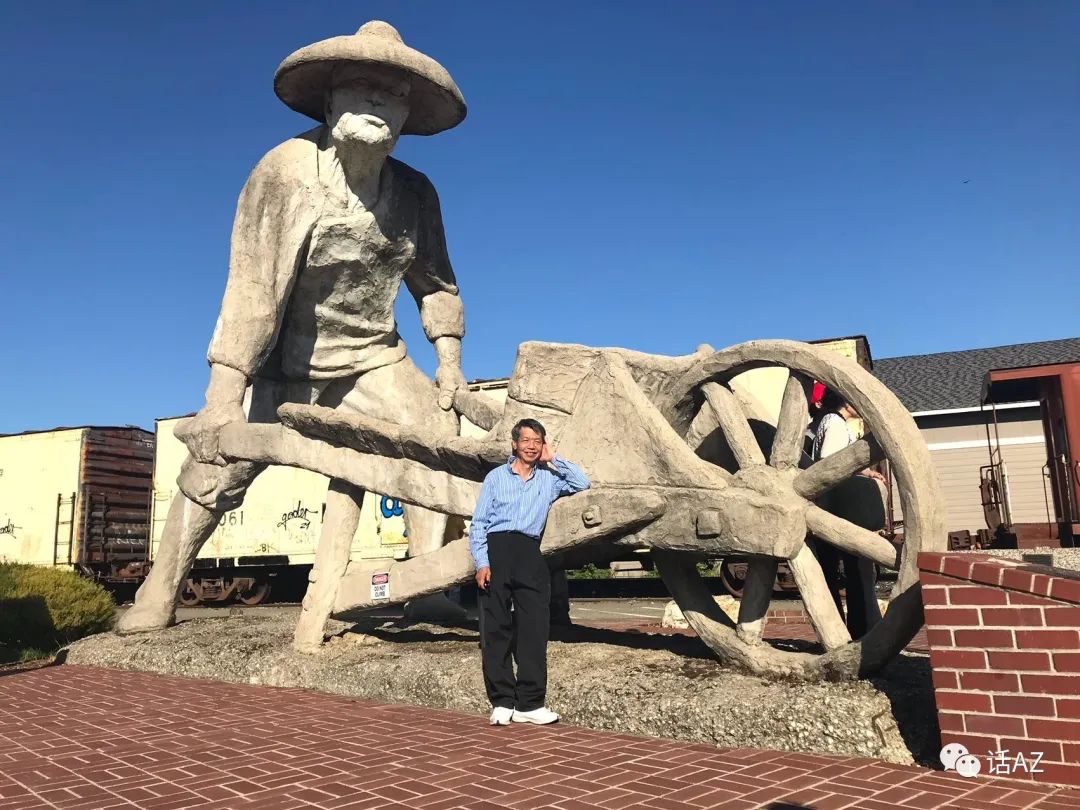
30-ton "Chinese Coolie" statue
In the Auburn area, in addition to gold mining, another major contribution of the Chinese was the construction of railways. The most difficult section of the Pacific Railway was built in Placer. In order to open up the Sierra Nevada Mountains, more than 5,000 Chinese workers participated in the construction, and more than 200 people were killed in the bombing. During the entire railway construction period, more than 1,200 Chinese workers died. On average, 3 Chinese workers were buried under sleepers every 2 miles on the section of road built by Chinese workers. That’s why some historians said, “Under every sleeper there is the body of a Chinese laborer!”
In the Railway Museum, I saw a photo of a family of early Chinese immigrants to the United States. Russell N. Rowe, a descendant of this family, has the following explanation: (Translation) My great-grandfather Honglihua and his brother Jihua participated in the construction of the transcontinental railroad. This is my most direct connection with American history. I stood in the dark, caressing the granite walls in the middle of the great tunnel at the top of the mountain where they had toiled for 15 months. Uncle Jihua lost an eye in an explosion. I can feel the presence of Chinese men 150 years ago. I am so proud of what these young people from Guangdong have achieved for themselves and the United States!
On May 10, 1869, Leland Stanford, the president of the Central Pacific Railroad Company, drove the last "golden spike" into the track with a silver hammer at Cape Peak, Utah, marking the completion of the first transcontinental railroad in the United States. The 1,776-mile rail line connects the Pacific Coast of San Francisco Bay to the existing eastern rail network. The completion of the railroad revolutionized the American economy, especially industries in the West, and demonstrated the historical contribution of Chinese Americans.
At the completion ceremony of the transcontinental railway, not a single Chinese laborer was seen!
The Chinese railroad workers who made the U.S. economy take off
The image of the "Chinese railroad workers" made of spikes
The statue of Chinese workers in the Railway Museum
Zhang Zhaohong wrote a poem:
"Tianjingsha. Chinese railroad workers in the United States"
baskets, bamboo hats and trousers,
across the oceans and waves.
The road tunnel collapsed and the rocks collapsed,
under the sleepers,
the male ghost refused to return home!
……………………………………
During this journey of digging for gold, building roads and finding roots, the author has written poems many times. No matter whether they are good or not, they are sparks of spiritual collision caused by touching the scene. The fact that the poems can be resonated and praised by everyone is the best support and encouragement for me.
When we arrived at the hotel that night, we were waiting to be assigned a room in the front lobby. Suddenly we heard our groupmate "Lao Wei" reading aloud "A Broken Wall" written by the author:
"This is a wall; this is a Broken Wall from a hundred years ago; this is the only "Southern Wall" left by the gold-mining Chinese! 1850 For years, thousands of Chinese workers, together with several wives, overcame countless hardships, just for one dream..."
Lao Wei is a native of Beijing. When he reads aloud, his words are clear and mellow, with clear cadences. The bass is deep and sensual, and the treble is sonorous and powerful. It is exceptionally pleasant and touching. He is a well-trained resonant master!
That night, I had a dream. I dreamed that Lao Wei was composing a poem for "A Broken Wall" in the TV series "Chinese Immigration":
"Today, I They came, stretched out their hands, touched the century-old history; took a photo, leaving countless thoughts. How to follow in the footsteps of our ancestors? How to rebuild our city wall! ..."
The sound of jade lingers for three days!
>Lao Wei and sister Zhang Sujiu took a photo
Sources and usage
This piece is republished or synchronized with permission and keeps a link back to the original source.