Pearl of the Desert | Chinese History in Arizona, USA (42) Chapter 4: Guan Chongqiong Family (4)
Chinese Soldiers in World War I When Guan Chongqiong returned to China to get married, the customs document he used was "Temporarily Leaving the United States to Travel to Foreign Countries", so he could not stay in China for a long time. Soon after getting married...
第一次世界大战中的华裔军人
Guan Chongqiong, a Chinese soldier in World War I, returned to China to get married. The customs document he used was "Temporarily Leaving the United States to Travel to Foreign Countries", so he could not stay in China for a long time. He separated from his wife shortly after their marriage, and when he returned to the United States, her wife was pregnant with their child.
The "Chinese Exclusion Act" is very harsh. Guan Chongqiong's wife cannot come to the United States. He wants to reunite his family. He can only hope that one day the Chinese Exclusion Act will be suspended, or he can return to his hometown after making more money. However, changes in the world situation brought another change to Guan Chongqiong's destiny.
In 1914, the First World War broke out and the war spread across the world. Most countries in the world were involved in this war. China's Beiyang government also declared war on Germany and Austria in August 1917. Although it did not directly send troops to participate, a total of 300,000 Chinese went to the European battlefield to undertake various logistical tasks for the Allied Powers.
In 1915, the cruise ship "Lusitania" full of American tourists was sunk by a German submarine. In 1917, Germany used unrestricted submarine warfare and sank many American ships. The United States severed diplomatic relations with Germany. Afterwards, Germany sent the "Zimmermann Telegram" to Mexico to help Mexico recover the lost territory ceded to the United States. In April of the same year, U.S. President Wilson decided to declare war on Germany.
Six weeks after the declaration of war, only 73,000 people in the United States volunteered to join the army. The shortage of troops and the urgency of the war required the U.S. government to propose a conscription bill to make up for the gap. On May 18, 1917, President Wilson signed the first U.S. military draft bill. 200,000 troops were sent to Europe to participate in the war.
The United States actually wants to share the results with the Allied Powers after the war. The United States issued a fourteen-point peace plan in January 1918. The second point is familiar to everyone: "The United States believes that as long as it is high seas, the United States has complete freedom of navigation, regardless of whether it is wartime."
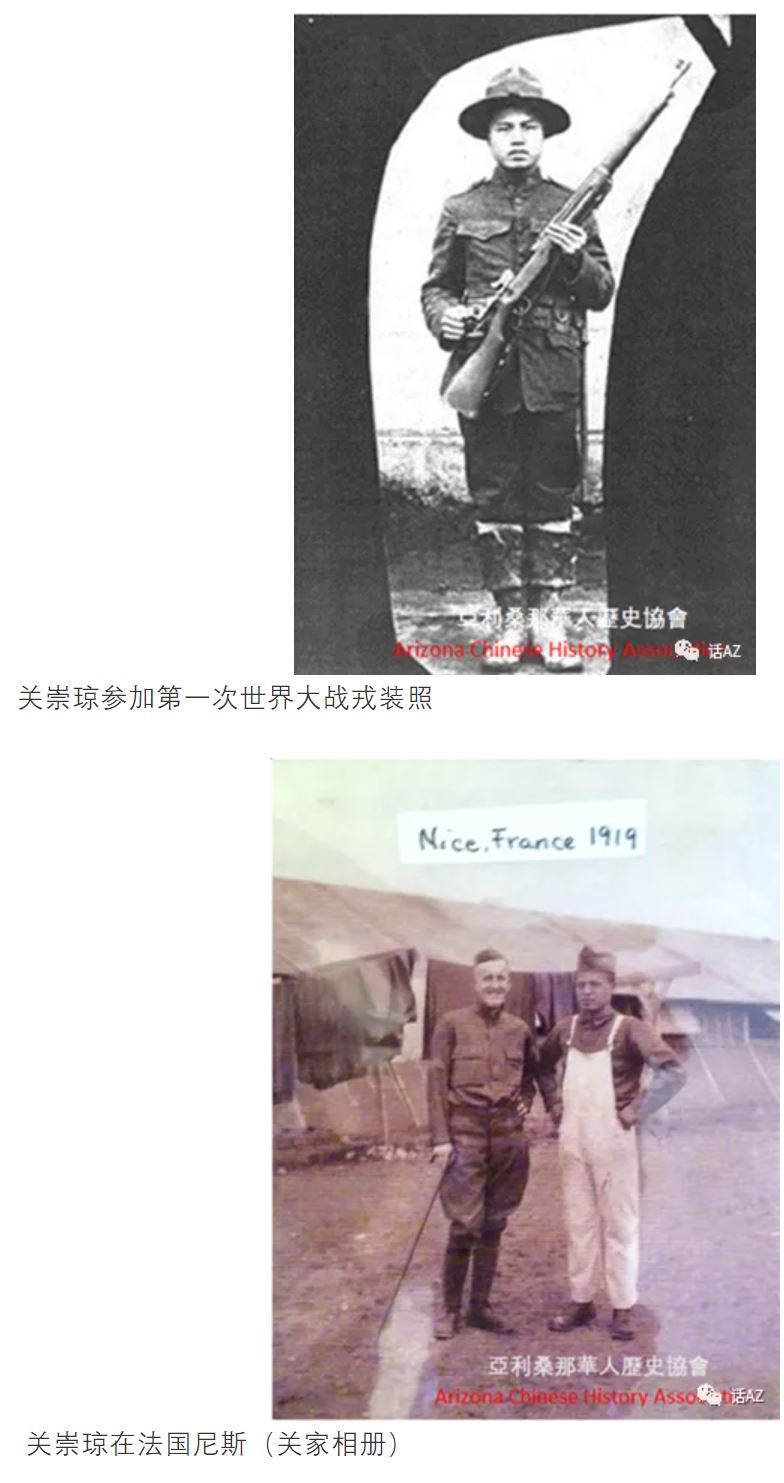
In October 1917, 24-year-old Guan Chongqiong was drafted into the military service. Before joining the army, he worked in a Citi Restaurant. He was one of two Chinese soldiers from Alberta who served in World War I. And left behind the only uniform photo of a Chinese-American serving in the army.
In October 1917, Guan Chongqiong received basic training with the Irish Fighting Division in New York. Later he was sent to the European battlefield. The unit he belongs to is the 164th Infantry Regiment of the American Expeditionary Force, and he works as a cook at the military headquarters.
Guan Chongqiong said that the troops took ships to go to Europe where the war was ongoing. Due to poor conditions on board, the soldiers were starving when the ship arrived at port. After they got off the boat, they dug up potatoes and ate them raw because they were so hungry.
The soldier's life is very lonely. He knows few people and has never received any mail. During World War I, there was the so-called "Christmas Truce," which generally referred to a brief, unofficial truce between armies on Christmas Eve or Christmas Day. Guan Chongqiong said that war was cruel and life as a soldier was lonely. Several of his comrades never received any mail from home. One of the fondest memories of the war was when his comrades shared with him the letters they had received on Christmas Eve.
> Guan Chongqiong has served at the headquarters of the 164th Infantry Regiment for 20 consecutive months. Battles were fought in Nice and Metz, France. The artillery fire during the war was fierce, and he was unfortunately injured. He was given anesthesia to remove the shrapnel in a field hospital.
In World War I, 65 million people participated in the war, more than 10 million people lost their lives, and 20 million people were injured, causing serious population and economic losses. Guan Chongqiong was a survivor of the war. He was awarded the "Purple Heart Medal" and the "European Victory Medal", becoming the first Chinese-American soldier in Alberta to receive military honors.
On November 11, 1918, the First World War ended. In March 1919, after recovering from his injury, Guan Chongqiong returned to Phoenix, United States from France and received a notice to retire.
After World War II, American veterans established the "Veterans Association", and Guan Chongqiong has been a member. Later, he was inducted into the "Alberta Veterans Hall of Fame" (there are only three Chinese-American soldiers in the state).
Guan Chongqiong started his own business after retiring and was very successful in running shops and real estate. Later he opened Kwan's Shangri-La Restaurant. Guan Chongqiong is a well-known overseas Chinese leader in the Chinese community. He is the founding chairman of the Greater Phoenix Overseas Chinese Association and the founding chairman of the Phoenix Longgang Group. He has made positive contributions to the overseas Chinese community. (to be continued)
Sources and usage
This piece is republished or synchronized with permission and keeps a link back to the original source.