Desert Pearl | Chinese History of Arizona, USA (31) The ninth-ranked city: Tempe (TEMPE)
Arizona Historical Association: Zhang Zhaohong The arrival of the railroad is an important milestone in the history of Arizona. Due to the harsh environment, mountainous and rugged countryside, private companies…
Arizona Historical Society: Zhaohong Zhang
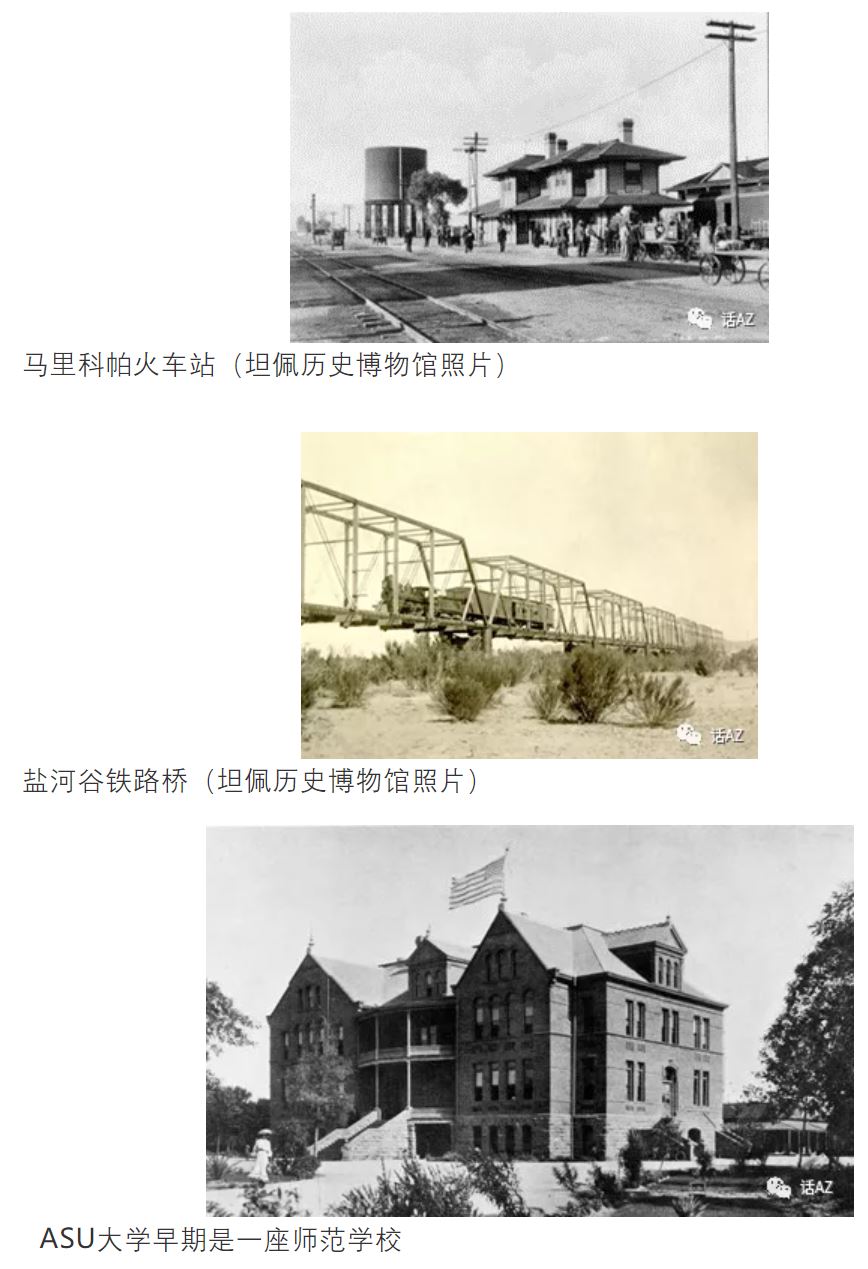
The arrival of the railroad was an important milestone in Arizona's history. Due to the harsh environment, mountainous and rugged countryside, there was little private enterprise, and the railroad changed all that. "To place TEMPE on the alignment, the connecting railroad line was moved three miles east to present-day MARICOPA, with the goal of placing the railroad in direct north-south alignment with TEMPE.
Tempe Normal School was established in 1885, changing its name to Arizona State University in 1958 University). This is a famous public research university. ASU's "Palm Avenue" has 110 palm trees and is a century-old landmark on the campus. The university has 6 campuses and 22 colleges. It is one of the universities with the largest number of students in the United States. In the 2020 census, TEMPE has a population of 180,587, ranking ninth in the province.
(TEMPE) The owner of "Guanghehao"
Chinese people have been making a living here in Tempe for a long time. Tang Xiaoxian, vice president of the Arizona Chinese Historical Association, was the first principal of the Chinese School in Tempe. He helped archaeologist K. J. Schroeder searched for clues about Chinese tombstones and wrote an article: "The Exploration of the Owner of the Centennial-Old Guanghe Store in Phoenix", which is excerpted below.
"In 1994, the second volume of the Archaeological Plan for the Ancestors and Military Memorial Cemetery in Phoenix, Arizona, 1990-1992" was published in 1994. On page 20 of the book, there is a photo of the Quong Hop & Co. Grocery opened by early Chinese businessmen, with the owner standing in front of the store. This photo, taken around 1890, was provided by the Arizona Historical Society and Miners’ Association.
The Chinese name of the owner of the Guanghe grocery store cannot be verified. U.S. government departments and newspapers are named after their business name, Quong Hop. Let’s call him Quong Hop’s boss.
On page 19 of the book, it is recorded that among the 23 Chinese ancestors whose remains are still in the Chinese burial circle, there is Quong Hop, the owner of the Guanghe Hao.
Donna Carr, a volunteer and historian in the Pioneers’ Cemetery Association (PCA), is enthusiastically involved in the investigation of the historical sites of the Chinese ancestors. She walked around Greenwood Memory Lawn, photographed all the tombstones in Chinese, and asked me to help her write down the names of the deceased in Chinese Pinyin so that she could compile an alphabetical index.
I asked Donner if she could help find information about the boss of Guanghe. She actually found the sixth page of the mainstream American social newspaper "The Arizona Republic" on August 5, 1903 and the third page of March 9, 1904, which both had reports about the boss of Guanghe. I am overjoyed, deeply grateful to Donna Carr, and in awe of her professionalism.
The boss of Guanghe is a native of Kaiping County, Guangdong Province, China. He was born in 1836 (the 16th year of Daoguang reign of the Qing Dynasty). In 1879 (the fifth year of the reign of Emperor Guangxu of the Qing Dynasty), he was 43 years old and middle-aged. Driven by family circumstances, he said goodbye to his wife and children and crossed the ocean alone to the United States. After the Chinese Exclusion Act was finally passed by the U.S. Congress in 1882, the vast majority of Chinese faced a dilemma: stay alone in the United States, or return to China to reunite with their families. The boss of Guanghe chose to stay in the United States. He later made a living by opening a grocery store in the Phoenix, Arizona, area.
The Arizona Republic's Page 6 Tempe (TEMPE) news column reported on August 5, 1903 that on the evening of Monday (August 3, 1903), just as the owner of the East Tempe businessman Guanghe was about to close his store, a Mexican came forward, holding a revolver, and asked the owner of Guanghe for money. The armed robber only got 4 US dollars and 2 cents, which was really not worth the loss. As of press time, the armed robber had not yet been captured.
At about 5 o'clock in the morning on March 8, 1904, the owner of Guanghe, one of the oldest and most famous Chinese people near Tempe (TEMPE), passed away. On the third page of the Arizona Republic on March 9, 1904, it was reported that the owner of Guanghe had passed away. The report said: A well-known Chinese gentleman passed away yesterday.
Boss Guanghe has been in the United States for 25 years and spent most of his time in the Salt River valley. Over the years, he has run many small businesses around Tempe. Three years ago to the present, his store opened about a half-mile from the cheese factory.
He has many friends, especially among children. He is everyone's happy fruit. He is known for his generosity. No matter what the children buy in his store, they always get small gifts such as candies.
His business prospered due to his generosity, and until his last illness, his business was quite successful.
The boss of Guanghe died at the age of 68. He had been in poor health for quite some time. It is said that he had suffered from lung disease for a long time, but the cause of his death may have been due to old age and overall physical exhaustion. He was seriously ill for about a month.
That morning, as soon as the boss of Guanghe passed away, someone notified his cousin Hi Wau (transliteration of Hi Wau) in Phoenix. The body of the Guanghe boss arrived at his cousin's house that afternoon, and the funeral was held the next day. The Guanghe boss left behind a wife and several children in China.
When Boss Guanghe lived in the United States, discrimination and racism against Chinese people were very serious in society. After the railroad company stopped recruiting Chinese workers, the U.S. government legislated to make it very difficult for American Chinese men to reunite with their wives in the United States. The boss of Guanghe died unable to bring his family to the United States from Guangdong, China. He spent his whole life alone and lonely in the United States from his middle age, which was indeed the bitterness and regret of the Chinese people at that time. "
The most Chinese businesses in Tempe are grocery stores and restaurants. We collected an advertisement for "THE BEET HOUSE" in the 1960s. The owner of the store was Allen M. Dong, who once served as the chairman of the "Arizona Chinese Chamber of Commerce."
Sources and usage
This piece is republished or synchronized with permission and keeps a link back to the original source.