Pearl of the Desert | Chinese History in Arizona, USA (20) Chinese Buildings in the Historical Heritage List (1)
> Arizona Chinese Historical Association: Zhang Zhaohong There are many Chinese historical buildings in Phoenix that are listed in the "Phoenix Historic Heritage List and the National Register of Historic Places" (thePho...
Arizona Chinese Historical Association: Zhang Zhaohong
Many Chinese historical buildings in Phoenix are listed in the Phoenix Historic Property Register and the National Register of Historic Places. In fact, Chinese grocery stores and attached dwellings are the most common types of properties associated with Chinese heritage in Phoenix. This article documents a total of 17 examples of historic buildings, with construction dates ranging from 1914 to 1951.
Typically, Chinese store owners learn Spanish first to ensure success in Spanish-speaking communities. Business success provides income and security, which requires hard work and long hours, which isolates some business owners from the rest of the Chinese community. This means that many businesses and properties provide accessory dwellings to their owners.
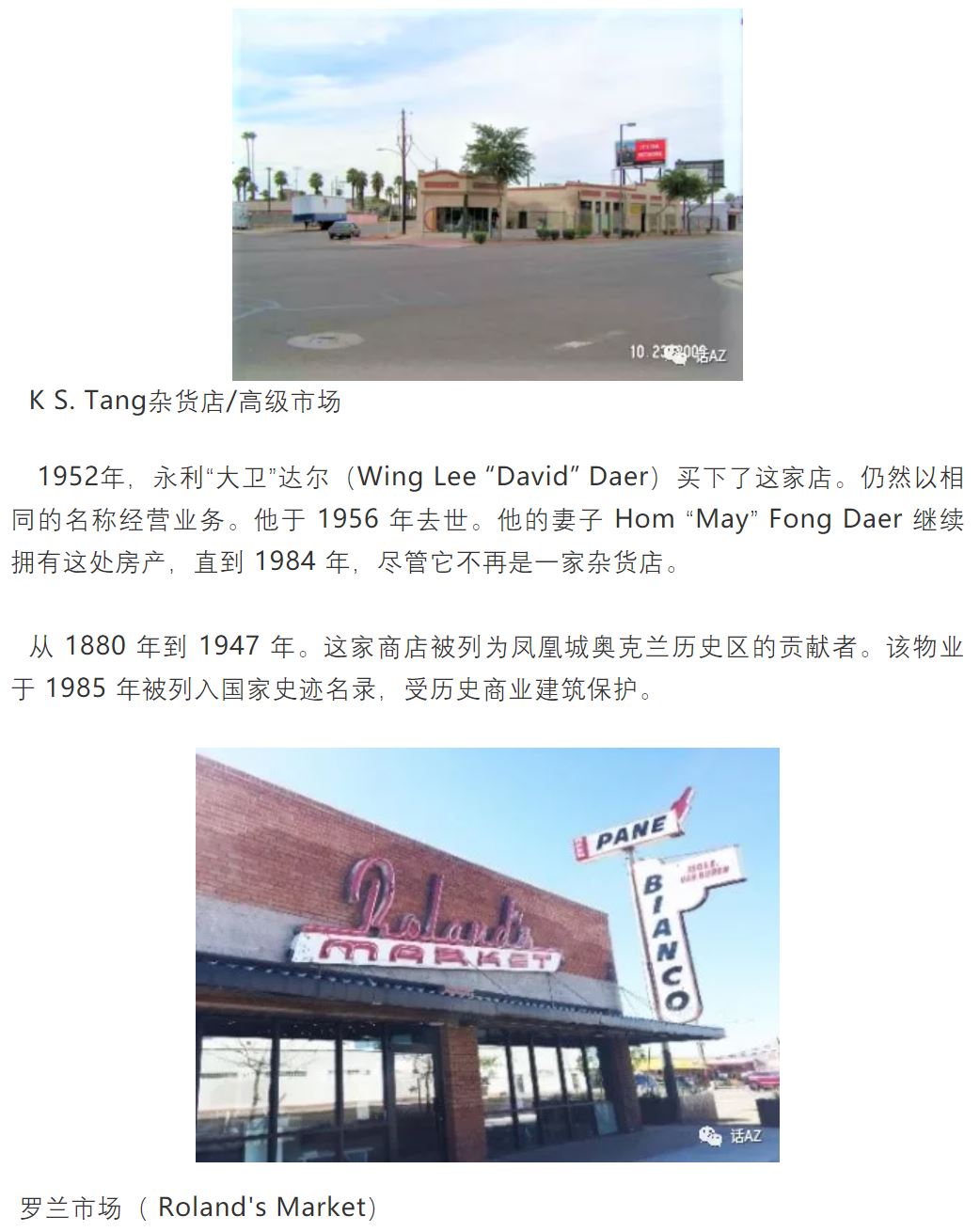
1. Historical name: K S. Tang Grocery / Superior Market
Address: 901 Grand Avenue Phoenix
K S. Tang Grocery / Superior Market is listed on the Phoenix Historic Heritage Register and the National Register of Historic Places, and is "as part of Oakland Historic District" District). Because of the historic building's ties to Phoenix's Asian American history, the property was a rare Chinese-owned grocery store and former residence from 1870-1960.
The building was built around 1914 and owned by Edward Durand in 1915. Over the next few years, the store had various operators and names: Yee Shin/Yung Yee Chee grocery (1916-1917); Sunlight (1918); Yuen Yee (1919-1920); Bela Berger (1921); Modern Grocery #2, (1923); Miller & Oglesby grocery (1925); and Thomas Stack grocery (1926).
In 1928, the building was bought by Chinese Kooi S. Tang and operated under the name of K S. Tang Grocery Store. From 1938 to 1958, the grocery store was named Superior Market. During this time, the owner no longer used the back of the store as a residence and moved to a few lots to the west of the store.
2. Historical name: Roland’s Market
Address: 1505 East Van Buren Street Phoenix
Roland’s Market is eligible for the City of Phoenix Historic Register and the National Register of Historic Places.
According to Criterion A, it relates to the historical context of Asian Americans in Phoenix, 1870-1960. The property is a rare example of a Chinese grocery store.
Constructed around 1917, the building served as C.P. La Grange's second-hand goods store until 1923, when D.S. Armstrong opened a grocery store here. From 1929 to 1940, it was operated by local and national grocery chains, including MacMarr (1931-1934) and Pay ‘n Takit/Safeway (1935-1941).
Around 1942, Chinese Roland Ong opened Roland’s Market in the building and ran the store with his family until the late 1970s. The store continues to operate as a grocery store but has recently been converted into a restaurant.
The building has undergone some minor changes over the years. However, it still retains many historic features, including a pressed metal ceiling inside and the walls are red brick. Additionally, a Googie-style neon sign remains on the front railing, as well as a free-standing electronic sign, both dating from the 1940-50s.
The building is in good condition. This is a 20th-century commercial-style building with some changes to the storefront, but it has a sufficient sense of history.
3. Historical name: Ah Gim Yaun Market
Address: 1002 South 4th Avenue Phoenix
Ah Gim Yaun is listed on the Phoenix Historic Heritage Register and the National Register of Historic Places.
Chinese Ah Gim Yaun was born in San Francisco in 1880 and moved to Phoenix in 1911. He opened a grocery store here around 1920. The property is a rare example of a Chinese-owned commercial and multi-unit residential complex.
In 1925, a residential duplex was added to the south side of the store, and later that year a residential duplex was added to the west side of the store. Other additions were added later. But it suffered fire damage sometime between 2005 and 2006. Akin and his wife lived in the largest apartment in the fourplex until Akin's death in 1959. His wife, Quan happy, continued to live here until her death in 1977. By 1997, his descendant Ann Quan sold the store, but the property remained in the family.
(References: 1, PHX GIS, Phoenix Bureau of Land Management, Esri, HERE, Garmin, INCREMENT P, Intermap, USGS, METI/NASA, EPA, USDA, powered by Esri. 2, CITY OF PHOENIX HISTORIC PROPERTY INVENTORY.)
Sources and usage
This piece is republished or synchronized with permission and keeps a link back to the original source.