Pearl of the Desert | Chinese History in Arizona, USA (17) Chinese Business History in Phoenix
(Arizona Chinese Historical Association: Zhang Zhaohong) In 1865, the territorial laws of the United States prohibited Chinese and interracial marriages. In 1882, the Chinese Exclusion Act prohibited Chinese...
(Arizona Chinese Historical Association: Zhang Zhaohong) In 1865, the territorial laws of the United States prohibited Chinese and interracial marriages. In 1882, the Chinese Exclusion Act prohibited Chinese labor immigration for ten years. However, the law provides some exemptions that allow businessmen, students, academics, and government officials to enter the United States legally even though they are denied the right to become naturalized citizens.
The Chinese Exclusion Act made it difficult for Chinese to immigrate with their families, which had a great impact on the career choices of Chinese men. Due to restrictions on inter-ethnic marriage, men had to return to China to find wives. These circumstances led Chinese men to strive to become businessmen. Once you become a restaurant or grocery store owner, you have the financial ability to marry a wife and bring your wife and children back to the United States from China.
However, it is not easy for new immigrants to become bosses when they come to the United States, especially for some "paper sons" who pretend to be relatives of other people. According to statistics, from 1910 to 1940, 80 to 90 percent of the 175,000 Chinese immigrants to the United States were "paper sons." At that time, some immigrants also crossed the border illegally from Mexico to the United States.
Many new immigrants still have to pay off debts and learn new languages after coming to the United States. After becoming familiar with the local environment and having a certain economic foundation, they had the desire to become property owners. However, whether you are opening a restaurant or running a grocery store, you need more funds, but due to lack of credit, it is difficult to get loans from banks. For this kind of difficulty, the clan members also have ways to help overcome it.
When the author was interviewing old overseas Chinese, I saw a name book of the "Hundred Sons Society" left by the Chinese senior Deng Kailong. The "Baizihui" was a clan organization at that time. Each clan member contributed a share of the money, and then pooled the money to help qualified villagers start their own businesses, and then returned it when they were able. In this way, you can raise the necessary funds to start a business without going through a bank. In the United States, groups composed of clan surnames have great cohesion to strengthen the unity of the tribe and help each other.
In 1900, there were three Chinese companies recorded in Phoenix Chinatown: Quen Yuen Company, Luck Hing and Lo Jan Store, and Sun KwongTong Company. There were also about 18 Chinese companies outside Chinatown. By the 1920s, Chinese grocers were growing and they could find suppliers and lines of credit in Los Angeles' Chinatown. By 1921, there were 34 Chinese grocery stores. By 1929, Chinese business records showed that there were 53 grocery stores at that time.
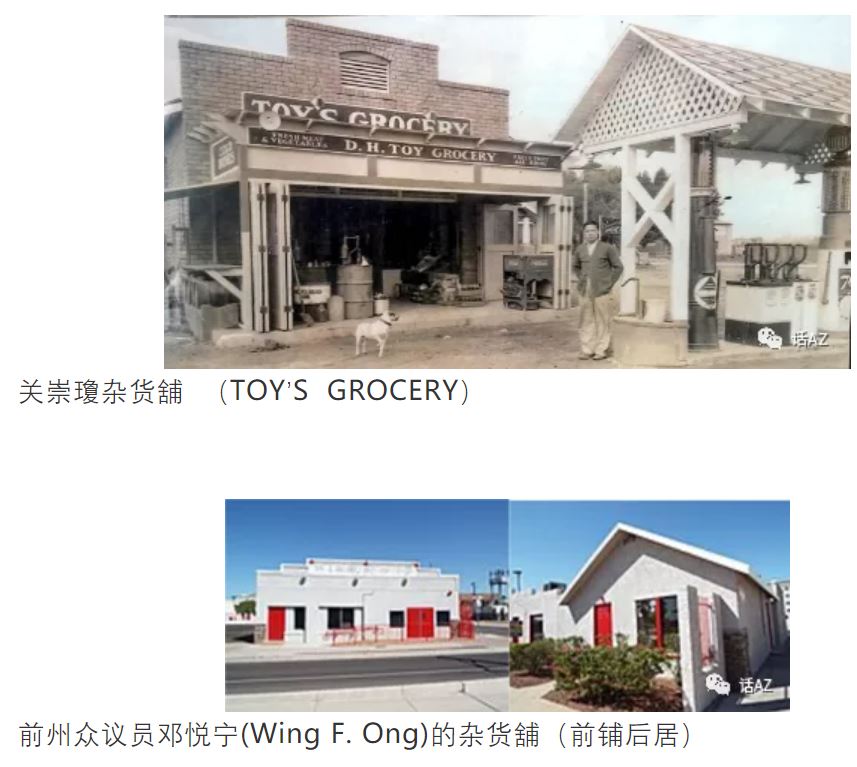
In 1927, Chinese Guan Chongqiong opened TOY’S GROCERY in Phoenix City, selling meat, vegetables, fruits and sodas, as well as gasoline and diesel. The historical photos left behind show the appearance of the early Chinese grocery store.
By the 1930s, there were more than 60 Chinese businesses in Phoenix, extending to Washington, Jefferson and Van Buren streets, with a grocery store on almost every block. In 1939, eleven people including Deng Kailong, Deng Anye, Guan Chongqiong, and Deng Yuening registered with the state government and established the "Arizona Chinese Chamber of Commerce." Chinese business owners come here regularly to discuss the common problems they face and work together to fight for the rights and interests of Chinese businessmen. By 1940, there were 47 Chinese grocery stores recorded in Phoenix.
Almost all the early new immigrants came from four villages in Guangdong: Taishan, Kaiping, Enping and Xinhui. They speak Siyi dialect, maintain their own language and culture, and have close ties with their hometown. In the Chinese community, the Deng surname is the largest ethnic group, and the Yu surname and Huang surname are also the largest families. Before many new immigrants come to Phoenix, their families at home and their relatives in the United States will make pre-arranged plans.
New immigrants are unable to live in most areas of Phoenix because of restrictions imposed by federal laws, state laws, and contracts. Nearly all immigrants lived in Chinatown or at their place of business, with upstairs rooms for staff. Laundry workers and grocery store employees live in apartments behind the store or in adjacent detached homes. In 1940, nearly a hundred families lived in the grocery store and the surrounding Chinese community.
Most Chinese grocery stores operate in the Hispanic and African communities in Phoenix, and the store owners need to learn to speak Spanish. Grocery stores are usually run by families, with a shop in the front and a living room in the back. Children have grown up in the shop and are familiar with its operations. They have to help the family business after school and during holidays. Chinese grocery stores are open almost all year round.
In the 1940s, Chinese enterprises continued to develop and shops expanded. In the 1950s and 1960s, the family business became more large-scale. For example, Guan Chongqiong and Deng Xinlong all owned their own shopping malls, which were self-operated and rented. Some companies also had chain businesses with other states. Former Peoria Mayor Egmund Tang is also a grocery store owner.
By 1970, according to collected information, the Phoenix area had 37 restaurants, 96 grocery stores, 16 liquor stores, 6 law firms, 6 insurance brokers, 5 medical clinics, as well as Guacai Food Company, import and export company, pest control company, copper and iron shop, optical shop, district attorney, etc. In addition, there were also real estate companies, stocks, and a TV repair shop.
In the 1980s, local Chinese had made great achievements in business. Among them were two large "FOODARAMA" supermarkets run by the Deng Huilin brothers, with an annual business volume of more than 5 million and a total of 100 employees. The American Business Daily also made headlines. After the 1990s, large supermarkets from out of state entered Phoenix, such as "Dahua Supermarket", "Xinxin Supermarket", etc. Food wholesale companies such as "China Noodle Factory", "Zhixing" and "Rongcheng" have also served the Chinese catering industry. In recent years, the "Mekong" run by Asians, as well as multiple "Lee Lee" supermarkets, and more Chinese stores have opened, bringing new prosperity.
As the older generation of overseas Chinese gradually retire and young Chinese have achieved academic success and are unwilling to take over, family-run Chinese restaurants and grocery stores are declining. The business model of self-employment by Chinese people a hundred years ago has become history.
(references and photos collected and photographed by the Arizona Chinese Historical Association)
Sources and usage
This piece is republished or synchronized with permission and keeps a link back to the original source.