Pearl of the Desert | Chinese History in Arizona, USA (5)
Arizona Historical Association: Zhang Zhaohong The Chinese in Flagstaff From the 1850s, the United States began to cross Arizona...
Arizona Historical Association: Zhang Zhaohong
Flagstaff (Flagstaff) ) of the Chinese
Beginning in the 1850s, the United States began surveying Route 35 across northern Arizona as a possible trade route with California. First a wagon road, then a railroad in 1851, the route would pass through Flagstaff. However, due to political, war and other factors, the railway did not pass through the area until 1882. [60]
>We collected the Chinese history of towns along the interstate railway. Flagstaff's Chinese population is associated with the city's tunnels.
According to Flagstaff Business News, [61] "Flagstaff's earliest tunnels date back to the 1880s and 1890s and were dug by Chinese residents. These residents were merchants and owned establishments such as restaurants and laundries. The Chinese residents were blamed for a fire that destroyed the city center in 1886, and there were rumors that they dug the tunnels as an escape route."
Joe Meehan, director of the Flagstaff Pioneer Museum, was quoted as saying in the report, "When the Chinese were driven out of Flagstaff, they would go to Williams or other locations out west to cool things down. Often they were falsely accused and hunted because they were causing bigger fires," Meehan said. "Larger tunnels do exist down several street alleys." "Pass between two buildings without getting a lot of business record books wet."
"There is a tunnel that extends from the basement of a store on the northeast corner of San Francisco Street and Railroad Avenue (Route 66) to the basement of another building half a block to the north. Gamblers used this tunnel to evade police raids and allowed their exit through the alley." "At the store's front counter, someone would press a button that would beep in the basement, alerting participants to escape," "Due to their small size, they had to crawl through a tunnel."
R. Sean Evans, an archivist at the Crane Library, sees it differently.
He said it was easy to conclude that because the tunnels were built after the era of railway construction, they were unlikely to have been built or used by Chinese railway workers. Due to its size and purpose, the tunnel is unlikely to host any form of illegal activity. Evans said that "most of the tunnels between buildings were built to facilitate their own business and were not wide." [62]
By the 1920s, Flagstaff was a town of several thousand people, and electric companies dug tunnels under buildings to deliver electricity. Like many construction projects, the 41 tunnels were dug mostly by Chinese workers who needed to work and worked for pennies. [63]
From the above reports, we can see that the society at that time had serious and inappropriate accusations and discrimination against the Chinese.
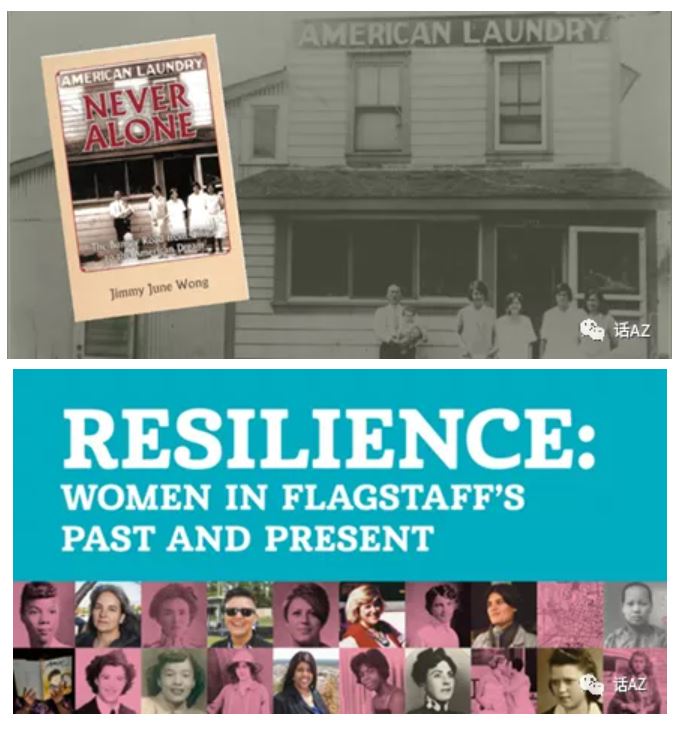
On August 23, 2019, there was a famous exhibition in Flagstaff called "Resilience: Women of Flagstaff Past and Present." This is a collaborative project between the Arizona Historical Society (AHS) and the Martin Springer Institute at Northern Arizona University. The exhibition shares the moving stories of twenty women who have faced tremendous challenges and overcame hardship, pain and disadvantage. [64] Xie Yao (English name: Dew Yu Wong), who immigrated from China to Flagstaff in the early days, is one of the characters in the exhibition. The work is on display at the Pioneer Museum and online.
New Chinese History Book "NeverAlone"
In March 2021, 80-year-old Jimmy June Wong published his new book "Never Alone". The author's Chinese name is pronounced "Wong Ben hai" (the author translated it as "Huang Binghai" because his brothers in the family are ranked with the character "Bing").
The author's grandfather was an immigrant from China in the 1850s. The story, based on many rare historical documents and photographs, tells the true story of his grandfather and parents and their nine siblings, and their efforts to adapt to the American way of life.
The author mentioned in the memoir "Never Alone" that if my grandfather had not planned to leave China to find a better life for my family, I would probably be barely surviving in rural China. Our attempts to put down roots in the United States were not easy. We encountered racism, the immigration nightmare on Angel Island, the Chinese Exclusion Act, and the constant fear of deportation as we tried to adapt. My father's first wife was a woman with "tied feet." We worked hard to create businesses like American Laundry and American Kitchen. We have a big family, we study hard in school, and everyone, no matter our age, works in the family business.
In 1915, Jimmy June Wong’s father Huang Shizhi (English name: June Wong) and mother Xie Yao (Dew Yu Wong) moved from San Francisco to the small town of Flagstaff, Arizona. They bought a laundry room and raised nine children, Jimmy being the youngest son. In the book, he shares his family's experience immigrating to the United States, as well as funny and poignant stories of his childhood and growing up. Many papers, pictures, documents and memorabilia about the family's history are preserved in the book, many of which are rare and cannot even be found in libraries or collections. [65]
>The author purchased this book. This is the only book chronicling the history of a Chinese family in Flagstaff, Arizona. This family has spanned six generations since the 1850s. The book contains many stories of early Chinese encounters, struggles, failures and successes, which is very contemporary. We will share the story with you in Chapter 4 of this article.
Photos from Jimmy June Wong's book: "Never Alone", Reference: 60https://enjoyflagstaff.com/brief-flagstaff-history
61.62 Flagstaff tunnels lead to a mysterious pastKatlyn Coveney Apr 28, 2017, 63 JimmyJune Wong “Never Alone”book p.48
64 https://arizonahistoricalsociety.org/events/resilience-women-in-flagstaffs-past-and-present-opening-reception.
65 https://books.google.com/books/about/Never_Alone.html?id=swaUzQEACAAJ
Sources and usage
This piece is republished or synchronized with permission and keeps a link back to the original source.