Tang Xiaoxian: Chinese Railway Workers and Stanford University (Photos)
Tang Xiaoxian: Chinese Railway Workers and Stanford University (Photos) Phoenix Tang Xiaoxian In May 1969, the first transcontinental railroad (Fi…
Phoenix Tang Xiaoxian In May 1969, at the 100th anniversary ceremony of the First Transcontinental Railroad in Utah, John Volpe, then U.S. Secretary of Transportation, ignored historical facts and said nonsense: "Who but Americans could have blasted tunnels through the Sierras? Who but Americans could have built tunnels in the Sierras? Who but Americans could have blasted tunnels through the Sierras? Who but Americans could have built 10 miles of track in one day?) He did not mention the Chinese workers who built the railway and their contribution. The descendants of the Chinese workers present were very unhappy. The first transcontinental railroad, built from 1863 to 1869 by the California Central Pacific Railroad and the Union Pacific Railroad, connected Council Bluffs, Iowa, and Omaha, Nebraska, to Oakland, California, on the east coast of San Francisco Bay. According to the original plan, such a huge project would take fourteen years to complete. Thanks to the participation of a large number of hardworking, diligent and intelligent Chinese workers, the construction period was shortened by half, and the railway connection was completed in seven years. On the roster of road construction workers, Chinese workers accounted for almost 95%. Connie Young Yu, 73, lives in Los Altos, a Bay Area city in California. She is a historian and writer. Her parents traveled from the Bay Area to Utah to attend the 100th anniversary of the first transcontinental railroad. On May 10, 1869, California railroad tycoon Leland Stanford drove the last golden spike at the point where the Union Pacific Railroad's east-west track connected with Promontory Point in Utah. After the completion of the transcontinental railroad, the population of the western United States increased rapidly and the economy developed rapidly. In 1891, Leland Stanford, who became California's senator and governor, and his wife, Jane Lathrop Stanford, founded Stanford University. The huge wealth created by the labor of Chinese railroad workers in the 1860s was the main source of funds needed by the Stanford couple to organize Stanford University. About 12,000 of the Chinese immigrants who came to the United States in the 1860s built railroads. For decades, Ms. Yu and general history enthusiasts who study early Chinese immigrants have spared no effort to discover their contributions after coming to the United States and their various experiences, but with little success. Finally, their research was supported by Stanford University. Scholars from Stanford University established the "Chinese Railroad Workers in North America Project". Since 2012, more than 100 experts, scholars and volunteers in the fields of anthropology, archaeology and other fields from the United States, Canada to Asia are engaged in research on this project. They work together to publish articles, books, produce digital files and images, and organize conferences and other public events. Hilton Obenzinger, deputy leader of the project team, said that without these Chinese workers, Stanford University would not be possible. Leland Stanford was rich, but it was because of the successful construction of the railroad that he became extremely wealthy. The reason why he was able to found this university was because Chinese laborers built this railway. Shelley Fisher Fishkin, director of the school's American Studies Office, said that in the payroll records of the Central Pacific Railroad, we saw a line of Chinese characters with excellent calligraphy, which may have been written by a scholar with an accountant background. Researchers believe that many Chinese workers were merchants, traders, and blacksmiths. They experienced the Opium War, the Taiping Rebellion, natural disasters and famine, and came to the United States in search of opportunities. The immigrants, many of whom are educated, come from the southern Chinese province of Guangdong. Gordon Chang, director of the Center for East Asian Studies at Stanford University, also said that not only were the Chinese workers physically strong, they also had the ambition to create a new life. They come from all walks of life, different social strata, and have different skills, including cooking, accounting, carpentry, and plastering. In early June this year, about 250 people went to Stanford University to attend a conference on early Chinese workers in the United States. Among them, about 50 descendants of Chinese railway workers came all the way from Hawaii. Through family genealogy tracing and the sharing of oral histories, new clues to research on the project were found.
Leland Stanford (1824-1893)
>Stanford hammered the famous golden spike
Central Pacific Railway construction site
Chinese workers who built the American Central Pacific Railway
On April 28, 1869, with skilled Railway construction workers, mainly Chinese workers, set a record of laying 10 miles of track in one day
The opening ceremony of the first transcontinental railway on May 10, 1869
Successful connection, representatives shaking hands
During the construction of the railway, the Chinese workers who made great contributions did not appear in the news photos of the railway's opening.
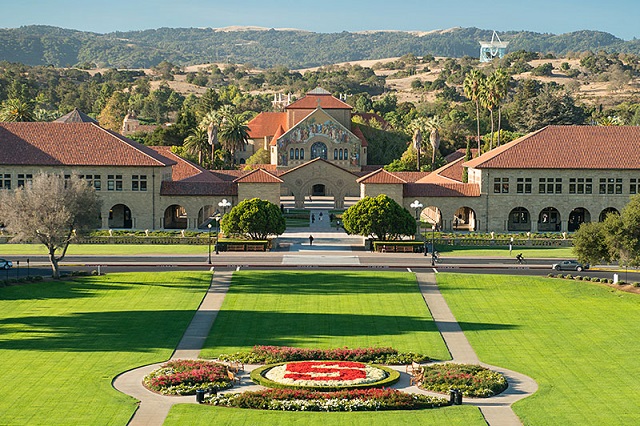
Stanford University Campus
In 2014, descendants of Chinese workers participated in the celebration of the 145th anniversary of the completion of the railway.
Sources and usage
This piece is republished or synchronized with permission and keeps a link back to the original source.